
Last Updated on September 20, 2026 by Gaurav Kumar
Quick answer: Army ranks in India run from Sepoy at the bottom to General at the top of the operational hierarchy, with Field Marshal as a ceremonial five-star rank above it. The Indian Army has 17 ranks in three groups: 10 commissioned officer ranks, 3 junior commissioned officer (JCO) ranks and 4 for soldiers and NCOs.
Army ranks in India confuse most people for one reason: the top of the ladder has two names. Field Marshal sits above General on paper, yet only two officers have ever held it. Below that, the ranks split into three groups, officers, junior commissioned officers and soldiers, and each group has its own titles, badges and career path. This guide lists every rank from lowest to highest, explains the three groups, and covers badges, appointments and pay levels. It also names who holds the top post as of September 2026.
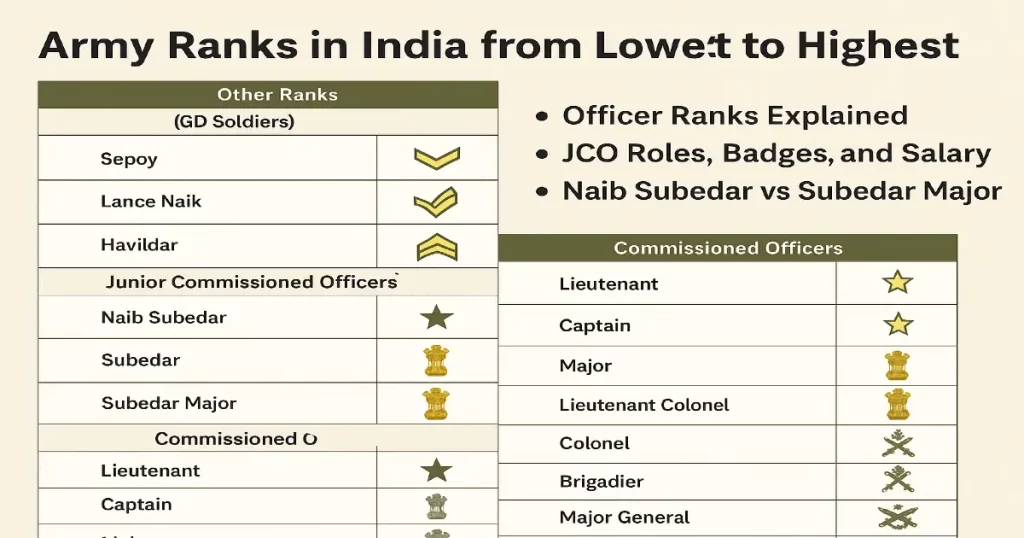
Army ranks in India from lowest to highest
Here is the full Indian Army rank list, bottom to top. There are 17 ranks if you count Field Marshal. I have left out Officer Cadet, which is a training status, and honorary ranks, which are covered further down.
| Order | Rank | Group | Note |
|---|---|---|---|
| 1 | Sepoy | Soldier | Sowar in cavalry; Gunner, Rifleman and others by corps |
| 2 | Lance Naik | NCO | Acting Lance Daffadar in cavalry |
| 3 | Naik | NCO | Lance Daffadar in cavalry |
| 4 | Havildar | NCO | Daffadar in cavalry |
| 5 | Naib Subedar | JCO | Naib Risaldar in cavalry |
| 6 | Subedar | JCO | Risaldar in cavalry |
| 7 | Subedar Major | JCO | Risaldar Major in cavalry |
| 8 | Lieutenant | Officer | Entry rank for commissioned officers |
| 9 | Captain | Officer | |
| 10 | Major | Officer | |
| 11 | Lieutenant Colonel | Officer | |
| 12 | Colonel | Officer | |
| 13 | Brigadier | Officer | One-star rank |
| 14 | Major General | Officer | Two-star rank |
| 15 | Lieutenant General | Officer | Three-star rank |
| 16 | General | Officer | Four-star rank, held by the Army chief |
| 17 | Field Marshal | Officer | Five-star, ceremonial |
Cavalry and armoured regiments use their own names for the same steps. The title Risaldar replaces Subedar, and Sowar replaces Sepoy. Naib Risaldar was called Jemadar until 1965.
Three facts this guide relies on
- The Army’s ranks fall into three groups, and there are ten commissioned officer ranks (Wikipedia).
- General Dhiraj Seth took over as the 31st Chief of the Army Staff on 30 June 2026 (PIB).
- The Major’s badge is the Ashoka emblem alone, and Captains and Lieutenants wear three and two stars (Zee News).
Indian Army rank structure: the three groups
The Indian Army rank structure has three tiers, and they carry different status:
- Group A is the commissioned officers: ten ranks, from Lieutenant to Field Marshal, equivalent to the All India Services.
- Group B is the junior commissioned officers: three ranks, equal in status to Group B gazetted officers.
- Group C is the non-commissioned officers and soldiers, also called other ranks: four ranks from Sepoy to Havildar.
This is the Indian Army hierarchy in one line: soldiers do the work, NCOs lead small teams, JCOs supervise, and officers command.
Promotion works differently at each end. For officers, substantive promotion up to Lieutenant Colonel depends on time in service. From Colonel upward it is based on selection, with time served also counting for Colonel. Because the pyramid narrows so quickly, most officers retire as Colonels, and only a few reach Brigadier or above.
A rank is what you hold, and an appointment is the job you do with it. The same rank can fill different jobs. This table shows typical jobs, and it changes by corps and regiment.
| Rank | Typical appointment |
|---|---|
| Major | Commands a company or equivalent unit |
| Lieutenant Colonel | Second in command of a battalion or regiment |
| Colonel | Commanding officer of a battalion or regiment |
| Brigadier | Brigade commander |
| Major General | General Officer Commanding a division |
| Lieutenant General | Commands a corps, or heads an army command |
| General | Chief of the Army Staff |
Indian Army soldier ranks
Four ranks make up the soldier tier. From the bottom: Sepoy, Lance Naik, Naik and Havildar. Lance Naik, Naik and Havildar are NCOs, and they wear one, two and three chevrons. Senior NCOs can be promoted to JCO on merit and seniority, limited by the number of vacancies.
What is the lowest rank in the Indian Army?
Sepoy is the lowest rank, and it carries no insignia. Many corps replace the name with a role title:
| Corps | Title |
|---|---|
| Artillery and Army Air Defence | Gunner |
| Rifle regiments | Rifleman |
| Parachute Regiment | Paratrooper |
| Corps of Engineers | Sapper |
| Corps of Signals | Signalman |
| Electronics and Mechanical Engineers | Craftsman |
Indian Army JCO ranks
JCOs sit between the NCOs and the officers. The three Indian Army JCO ranks are Naib Subedar, Subedar and Subedar Major. They are promoted up from the NCO ranks, not commissioned through the academies, and they hold a separate status with their own mess. A JCO badge carries a band of three braid strands (crimson, yellow, crimson) below the rank mark.
Subedar Major is the senior-most JCO. All ranks address JCOs as “Sahab”, a mark of the respect the position carries.
Indian Army officer ranks
There are nine working Indian Army officer ranks, plus the ceremonial Field Marshal. From the bottom: Lieutenant, Captain, Major, Lieutenant Colonel, Colonel, Brigadier, Major General, Lieutenant General and General.
New officers join as officer cadets, called Gentlemen Cadets or Lady Cadets, and wear no insignia. The rank of Second Lieutenant is no longer used, so every new officer is commissioned as a Lieutenant.
What is the highest rank in the Indian Army?
Field Marshal is the highest rank on paper, and General is the highest rank that anyone actually serves in.
Field Marshal is a five-star rank awarded only for exceptional wartime leadership, and it is not part of the Army’s organisational structure. Only two officers have received it: Sam Manekshaw in 1973 and K. M. Cariappa in 1986. General is a four-star rank and is held only by the Chief of the Army Staff. Cariappa was the first Indian to reach it, in January 1949, as Commander-in-Chief.
The Chief of Defence Staff is a separate four-star post. It can go to an officer from any of the three services, and the holder wears a unique insignia: a gold-wreathed tri-service emblem, not the Army’s badge. The post was created by a Cabinet decision in December 2019.
Who holds the top Army post in 2026
General Dhiraj Seth took over as the 31st Chief of the Army Staff on 30 June 2026 (official). He succeeded General Upendra Dwivedi, who retired that day. Seth is an NDA alumnus commissioned into the Armoured Corps in December 1986.
The Army chief retires at 62 or after three years in the post, whichever comes first. General Dwivedi, born on 1 July 1964, left after two years, which fits the age limit and not the three-year one. For the current Chief of Defence Staff, check the Ministry of Defence, since the post rotates.
Indian Army ranks and insignia
The Indian Army rank insignia use stars, the Ashoka emblem, a crossed sword and baton, and chevrons. The Army’s own site, indianarmy.nic.in, is where the official badges are published. Here is how each rank is marked:
| Rank | Insignia |
|---|---|
| Field Marshal | Ashoka emblem over a crossed sword and baton, in a lotus blossom wreath |
| General | Crossed sword and baton, with a five-pointed star and the Ashoka emblem above |
| Lieutenant General | Crossed sword and baton, with the Ashoka emblem above |
| Major General | Crossed sword and baton, with a five-pointed star above |
| Brigadier | Three stars in a triangle, with the Ashoka emblem above |
| Colonel | Two stars, with the Ashoka emblem above |
| Lieutenant Colonel | One star, with the Ashoka emblem above |
| Major | Ashoka emblem only |
| Captain | Three stars |
| Lieutenant | Two stars |
| Subedar Major | Ashoka emblem, with the JCO braid band |
| Subedar | Two stars, with the JCO braid band |
| Naib Subedar | One star, with the JCO braid band |
| Havildar | Three chevrons |
| Naik | Two chevrons |
| Lance Naik | One chevron |
| Sepoy | None |
The design has a history. India kept the British-era Tudor Crown and pip after independence in 1947. In 1949 Lord Mountbatten sent Prime Minister Jawaharlal Nehru a note proposing that the crown be replaced by the Lion Capital of Ashoka and the pip by a star. The changes took effect when India became a republic on 26 January 1950. The Indian Express explainer covers the background.
Pay level and service limits by rank
Each rank sits on a pay level, and each has a service limit. These are the figures as listed for the 7th Pay Commission structure. Check current Ministry of Defence orders, since a newer pay commission could change the levels.
| Rank | Pay level | Retirement |
|---|---|---|
| General | 18 | 62 or 3 years in the post (Army chief) |
| Lieutenant General | 15 to 17 | 60 |
| Major General | 14 | 58 |
| Brigadier | 13A | 56 |
| Colonel | 13 | 54 |
| Lieutenant Colonel | 12A | Not listed |
| Major | 11 | Not listed |
| Captain | 10B | Not listed |
| Lieutenant | 10 | Not listed |
| Subedar Major | 8 | 34 years of service or age 54 |
| Subedar | 7 | 30 years or age 52 |
| Naib Subedar | 6 | 28 years or age 52 |
| Havildar | 5 | 26 years or age 49 |
| Naik | 4 | 23 years or age 49 |
| Lance Naik | 3 | 19 years or age 48 |
| Sepoy | 3 | 15 years 56 days or age 42 |
For JCOs and soldiers the limit is whichever comes first, service or age.
How each group is entered
Officers train as cadets at the National Defence Academy, the Indian Military Academy or the Officers Training Academy, after clearing a Services Selection Board interview. JCOs are promoted from the NCO ranks, though a few enter directly as religious teachers or in technical arms such as the Corps of Engineers. Soldiers join at the bottom, as Sepoy or the regimental equivalent.
Honorary ranks and how to address a retired officer
Honorary ranks are given for service or to honour public figures, and they may carry no pay or pension. Several are in the Territorial Army: M. S. Dhoni received Lieutenant Colonel in 2011 in the Parachute Regiment. In October 2025, javelin thrower Neeraj Chopra was conferred the rank of Lieutenant Colonel.
A retired officer is addressed as “Rank ABC (Retd)”, as in “Brigadier Sant Singh (Retd)”. The Army issued a circular on this on 21 July 2014, and its reasoning was that rank never retires, the officer does.
Before you save this list
The main thing to remember about Army ranks in India is the three-group split: soldiers and NCOs, JCOs, then officers, with General as the top working rank and Field Marshal as an honour. Save the table above, and check the Army’s own website if you need a badge described exactly. For the current Army chief, the 30 June 2026 handover is the latest official change.
FAQs
What are the ranks in the Indian Army from lowest to highest?
The Indian Army ranks run: Sepoy, Lance Naik, Naik, Havildar, Naib Subedar, Subedar, Subedar Major, Lieutenant, Captain, Major, Lieutenant Colonel, Colonel, Brigadier, Major General, Lieutenant General, General and Field Marshal. Sepoy is lowest, General is the highest working rank, and Field Marshal is ceremonial.
What is the highest rank in the Indian Army?
Field Marshal is the highest rank in the Indian Army on paper. It is a ceremonial five-star rank, and only two officers have held it: Sam Manekshaw in 1973 and K. M. Cariappa in 1986. General is the highest rank in active service and belongs to the Chief of the Army Staff.
What is the lowest rank in the Indian Army?
Sepoy is the lowest of the Indian Army soldier ranks, and it carries no insignia. Many corps use role titles instead, such as Gunner, Rifleman or Sapper, and cavalry units use Sowar. A Sepoy can move up through Lance Naik, Naik and Havildar, and later to JCO rank.
What are the officer ranks in the Indian Army?
The commissioned Indian Army officer ranks are Lieutenant, Captain, Major, Lieutenant Colonel, Colonel, Brigadier, Major General, Lieutenant General, General and the ceremonial Field Marshal. That makes ten. Second Lieutenant is no longer used, so new officers are commissioned as Lieutenants.
How many ranks are there in the Indian Army?
There are 17 ranks in the Indian Army if you count Field Marshal: 10 commissioned officer ranks, 3 JCO ranks and 4 ranks for soldiers and NCOs. Excluding the ceremonial Field Marshal, the working hierarchy has 16. Officer Cadet is a training status, and honorary ranks are counted separately.
Is Second Lieutenant a rank in the Indian Army?
No. The rank of Second Lieutenant is no longer used in the Indian Army rank structure. Every new officer is commissioned as a Lieutenant, who wears two stars, after finishing training as an officer cadet. Past holders of the rank include Arun Khetarpal and Rama Raghoba Rane.