
Last Updated on November 1, 2025 by admin
If you have just completed your 12th in the science stream (with subjects like Physics, Chemistry, Mathematics and/or Biology) and are looking for a stable, respectable and rewarding career — you’re in the right place. This article will walk you through why science students are well-suited for government jobs after 12th, what you must check before you apply, what the best job options are, how you can prepare, and how you can grow over time. We’ll use factual data, authoritative references and concrete steps to ensure you’re ready.
- Why Science Students Should Aim for Government Jobs After 12th
- Eligibility & Key Considerations Before You Apply
- Best Government Job Options After 12th for Science Students
- Exam & Selection Process – How to Prepare Strategically
- Advantages & Challenges of Choosing Government Jobs After 12th for Science Students
- How to Make the Most of Your Science Background
- Pathways for Growth After Entering a Government Job with 12th Science
- How to Get Started Right Away: Practical Steps for Science Students
- Conclusion
- Q1. What are the best government jobs after 12th for science students without a degree?
- Q2. Does being from science stream (PCM/PCB) help in government job selection after 12th?
- Q3. If I take a government job after 12th, can I pursue further studies (diploma/degree) later?
- Q4. How long should I prepare to crack a government job after 12th with science background?
- Q5. Are there any disadvantages to starting a government job after 12th instead of full degree?
Why Science Students Should Aim for Government Jobs After 12th
The Science-Stream Advantage
Students who complete 12th with a science background bring more than just certificate: you develop analytical thinking, quantitative reasoning, scientific mindset and problem-solving approach. These strengths map really well to many government roles — especially technical or semi-technical ones. For example, jobs under the technical trades or in defence often require knowledge of mathematics, physics or logical reasoning. This gives you a clear edge in the candidature for “government jobs after 12th for science students”.
Stability, Respect & Early Start
Government sector jobs continue to offer reliability in India — job security, fixed pay structures, government benefits, allowances and social esteem. According to an article by Careers360, many high-salary government job roles after 12th pass exist, offering between ₹3.5 lakh to ₹12 lakh per annum for suitable posts.
Because these jobs often accept 12th pass and sometimes 12th science pass candidates, you can start earning early rather than wait years for a degree. That helps you build experience and financial independence early.
Targeting for Science Stream Specifically
When the phrase “government jobs after 12th for science students” is used, it emphasises two things: you already completed 12th (so eligible) and you come from the science stream (which gives you the technical/quantitative background). Many recruitment notifications explicitly list “12th with Physics & Maths” or “12th science” as criteria. For example the blog on MindGroom lists top competitive exams after 12th science including technical entries to defence and air force.
Hence, by choosing roles tailored to your background you leverage your strength rather than compete blindly.
Eligibility & Key Considerations Before You Apply
Minimum Educational & Stream Requirements
-
Most posts require 10 + 2 (12th standard) pass from a recognised board.
-
For many technical roles (especially for science students) it may require 12th with Physics, Chemistry and Mathematics (PCM) or similar subjects. For example, for roles in defence or air force: “12th (PCM) with English” etc.
-
Some non-technical posts may accept any stream after 12th, but since you have science, you should aim for higher-value roles that exploit your science knowledge.
Age, Physical Fitness & Other Criteria
-
Age limits vary depending on the job, organisation and category of candidate (General / SC/ST / OBC) — typical age limits are about 17-22 or 18-23 for certain posts.
-
Physical fitness, height, vision requirements apply especially in defence, paramilitary or technical trades with field work.
-
Nationality/residency: Usually Indian citizen; sometimes domicile for state-jobs.
-
Other criteria: computer literacy, typing speed (for clerical jobs), trade test/technical skills (for technician posts) etc.
Always check the job notification for “government jobs after 12th for science students” you are targeting.
Why Your Science Background Helps You
-
Your science stream training means you have familiarity with quantitative subjects — these often help in reasoning/quantitative aptitude sections of selection tests.
-
Technical posts particularly value science-stream candidates because they can assimilate technical training more rapidly.
-
By selecting roles that mention “science students” or “PCM required” you reduce competition from non-science candidates.
Best Government Job Options After 12th for Science Students
Here are some of the top career options that specifically align with the science-stream after 12th. We’ll cover what they are, why they suit you and what to expect.
Defence & Armed Forces Technical Entry
-
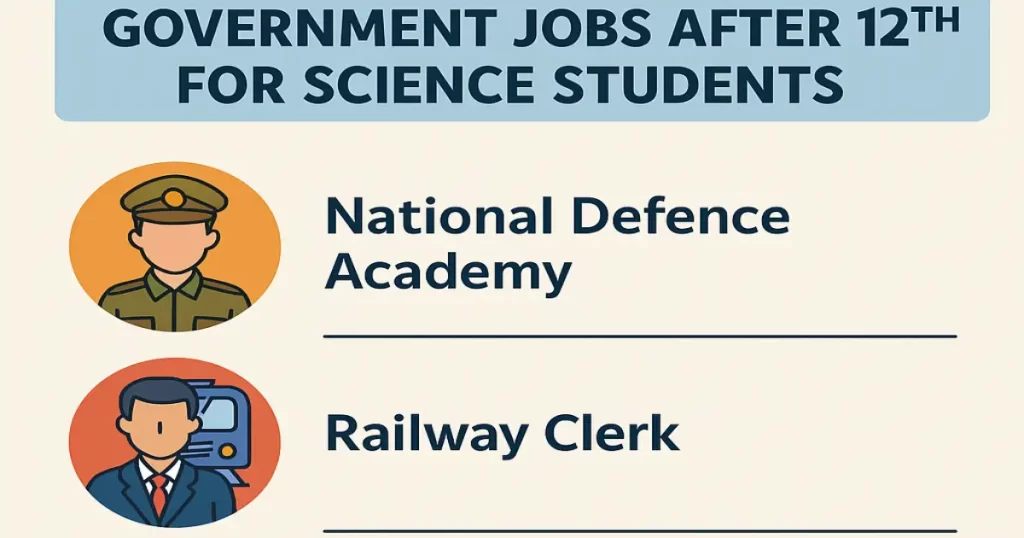
For example, the Union Public Service Commission (UPSC) conducts the National Defence Academy (NDA) exam which allows 12th science students (especially with PCM) to join the Army, Navy or Air Force officer cadre.
-
The Indian Air Force (IAF) Group X & Y entry: 12th science students are eligible for technical trades.
-
Why this is a great fit: You combine your science background with technical training, you get early start, excellent perks, national service and long-term career options.
Railways – Technical & Non-Technical Posts
-
The Railway Recruitment Board (RRB) offers posts such as NTPC (Non-Technical Popular Categories), ALP and Technician roles where 12th science is accepted.
-
Roles include Junior Technician, Commercial Apprentice, Ticket Clerk, etc.
-
Why suitable: Railways is one of India’s largest employers, offers job stability, widespread geographical presence and clear grade promotions.
Staff Selection Commission & Clerical / Technical Jobs
-
The Staff Selection Commission (SSC) CHSL (Combined Higher Secondary Level) exam accepts 12th pass candidates and is open to anyone with 12th. For science students, aiming for technical clerk/assistant posts is logical.
-
Also, SSC Stenographer, DEO (Data Entry Operator) posts are accessible.
-
Why this path: These roles are less physically demanding than defence/trades, have fixed office hours, and you can combine work with further studies.
Technical Apprenticeships, PSUs & Research Organisations
-
Public Sector Undertakings (PSUs), research labs and technical organisations sometimes hire 12th science + ITI/technical trade candidates for technician posts. For example, technical entry positions in engineering labs.
-
Why this matters: You begin your technical career early, build experience, and then can transition to diploma or engineering later to grow.
Exam & Selection Process – How to Prepare Strategically
To get a government job after 12th with a science background, you must prepare smartly. Below is how.
Understand the Exam Pattern & Syllabus
-
Most competitive exams for 12th pass jobs include: Objective Test (Quantitative Aptitude, Reasoning, English, General Awareness), followed by Skill Test / Technical Test / Physical Test (for trade/defence/jobs).
-
For science students aiming technical posts: expect mathematics/physics questions, general science, logical reasoning.
-
Before applying: carefully read the specific notification for “government jobs after 12th for science students” to know syllabus fully.
Use Your Science Background to Your Advantage
-
For quantitative aptitude: your maths training helps.
-
For technical/physics or electronics segments: your science stream helps.
-
For reasoning/logical: build on your analytical mindset.
-
But don’t neglect: English, General Knowledge, Computer Basics — many candidates from science stream may need to reinforce these.
Time-Management, Mock Tests & Strategy
-
Create a study timetable: e.g., 2-3 hours daily for aptitude & reasoning + 1 hour for GK + weekend practice tests.
-
Use previous year papers: many blogs emphasise the merit of practising past papers for 12th pass govt jobs.
-
For technical posts, besides written test, train yourself for the skill/technical test (e.g., trade test, computer typing, physical fitness).
-
Keep track of notifications and deadlines: roles for 12th pass open frequently (see job listings for 2025).
-
Stay disciplined: aim for accuracy and speed.
Advantages & Challenges of Choosing Government Jobs After 12th for Science Students
Advantages
-
Early income: Rather than waiting for graduation, you begin working early, gaining experience.
-
Fixed career path: Government sector offers structured pay increments, allowances, benefits, work-life balance.
-
Specialised roles: With science background, you can target technical jobs that might pay more and have better growth.
-
Respect & security: Government jobs are seen as prestigious, and you’re less vulnerable to private sector volatility.
Challenges & How to Overcome Them
-
Competition: Many aspirants aim for “government jobs after 12th” — especially non-technical ones. You must differentiate via your science background or extra qualifications.
-
Limited initial scope: Some posts may still require graduation for higher roles; starting with 12th pass role may limit immediate growth. Overcome by planning for further studies (diploma, degree).
-
Technical or physical demands: For certain defence/trade jobs, you’ll need fitness, physical test, or technical training. Be prepared mentally and physically.
-
Geographical postings / transfers: Government jobs may involve postings away from home. Think ahead — if you want stable location, choose accordingly.
How to Make the Most of Your Science Background
-
Emphasise your science course in applications — list subjects and performance.
-
While preparing, focus on maths, physics, logic — they help especially for technical posts.
-
Consider doing a short diploma or certificate (on weekends or part-time) to boost credentials.
-
Build computer skills — many tests and jobs expect basic computer literacy.
Pathways for Growth After Entering a Government Job with 12th Science
Landing the job is just the beginning. With your science background, you can climb further.
Upskilling & Further Qualifications
-
Enrol in a diploma (e.g., in engineering trades, electronics, computer application) or distance BSc/BTech later.
-
Certifications: computer proficiency, electronics technician, CAD, programming basics enhance your profile.
-
Upskilling gives you eligibility for promotions or lateral shifts into more prestigious roles.
Promotion & Specialisation
-
Many organisations offer internal exams/promotions: e.g., technician → supervisor → section engineer.
-
With a technical track you may become a “technical supervisor,” “junior engineer,” etc.
-
Your science foundation helps in advancing into specialist or technical leadership roles.
Transitioning from Entry-Level to Higher Roles
-
Use your entry role for learning: observe, ask questions, volunteer for additional duties.
-
Build domain knowledge: for example if you’re in railways technical role, learn about signalling, electronics or maintenance.
-
Network, mentor, set goals: say “in five years I aim to become X” and plan accordingly.
-
Your science stream will serve you well in these transitions because you already have the analytical and technical mindset.
How to Get Started Right Away: Practical Steps for Science Students
Step 1: Short-List Target Jobs
-
Write down 2-3 roles you are eligible for (12th science): e.g., RRB NTPC Technical, IAF Group X, SSC CHSL technical/clerical.
-
Check eligibility: stream (science), age, subject requirement, notification date.
-
Mark next notification date and deadline.
Step 2: Create a Preparation Plan
-
Week 1: Understand exam pattern, download syllabus, collect previous year papers.
-
Weeks 2-4: Cover Quantitative Aptitude + Reasoning + English + GK basics (1.5 hrs daily). Since you’re from science stream, integrate maths and logic application.
-
Weeks 5-8: Focus on technical sections (physics, electronics, trade knowledge) if the job demands; add mock tests on weekends.
-
Weeks 9-12: Full-length mock tests, revision, subject-wise drills, focus on speed and accuracy.
-
Ongoing: Physical fitness/skill test practice if required (especially for defence/trade roles).
Step 3: Application & Documentation
-
Keep all documents ready: 12th mark-sheet, certificate, ID proof (Aadhaar), passport-size photo, category certificate (if applicable) etc.
-
Fill application promptly when notification opens. Pay attention to eligibility, application fee, deadlines.
-
Submit correctly and print/keep confirmation receipt.
-
After applying: continue preparation until exam and selection process completes. Don’t stop after application.
Step 4: Stay Updated & Adapt
-
Regularly check official portals (RRB, SSC, UPSC, State PSC) for relevant notifications. For example, many job listings for 12th pass are published in 2025.
-
Join forums, job alert websites or WhatsApp groups to receive updates “government jobs after 12th for science students”.
-
Adapt your preparation based on latest exam patterns or changes.
Conclusion
For science students who have completed their 12th, the prospects of a government job are both real and promising. By targeting government jobs after 12th for science students, you play to your strengths — analytical thinking, quantitative aptitude, scientific mindset — and gain early access to stable, respectable employment. The path involves knowing the eligibility criteria, choosing the right role, preparing with discipline, and constantly up-skilling for growth. The first job is a launch pad, not the destination. If you keep your vision clear, leverage your science background intelligently, and act with consistency, you can build a rewarding government career with long-term growth. Start now — map your target, start studying, and step into the future you deserve.
FAQs
Q1. What are the best government jobs after 12th for science students without a degree?
A1. Some of the best options for science students who have just completed 12th and do not yet hold a degree include: technical trainee posts in railways (RRB NTPC technical/technician), defence airmen technical entries (IAF Group X), clerical/assistant roles in SSC CHSL with a science background, and PSUs technician/apprentice roles. These roles exploit your science training and you begin working early.
Q2. Does being from science stream (PCM/PCB) help in government job selection after 12th?
A2. Yes — your science stream advantage lies in your subject strengths. Many government job selections include quantitative aptitude, reasoning, mathematics or technical trade sections where your training helps. Additionally, some technical posts explicitly require 12th with PCM. Your stream gives you a niche.
Q3. If I take a government job after 12th, can I pursue further studies (diploma/degree) later?
A3. Absolutely. In fact, many people start working after 12th and simultaneously or later pursue a diploma, part-time degree or distance learning while working. This dual approach allows you to earn early and upgrade your qualification to aim for higher posts.
Q4. How long should I prepare to crack a government job after 12th with science background?
A4. The preparation timeline depends on the job type and your current proficiency. For a 12th science student with decent maths and reasoning, a focused 3-4 month study schedule (2-3 hours per day) can be practical for many jobs. If you are weaker in English or reasoning, allocate more time. Importantly, consistency beats cramming.
Q5. Are there any disadvantages to starting a government job after 12th instead of full degree?
A5. One potential disadvantage is that initial roles may have limited growth compared to graduate-entry posts. But this is offset if you keep upgrading your skills and qualifications. Also, some specialist or senior roles require higher qualifications — but your science background plus further study can overcome that. The key is to view the 12th-pass role as a launch pad, not a stop.