
Last Updated on January 24, 2026 by Gaurav Kumar
Do you dream of a career defined by stability, respect, and service to the nation? You are not alone. Every year, over 20 million aspirants vie for the coveted Sarkari Naukri (Government Job). However, nearly 30% of applications are rejected solely due to technical errors, missed deadlines, or incorrect document formatting.
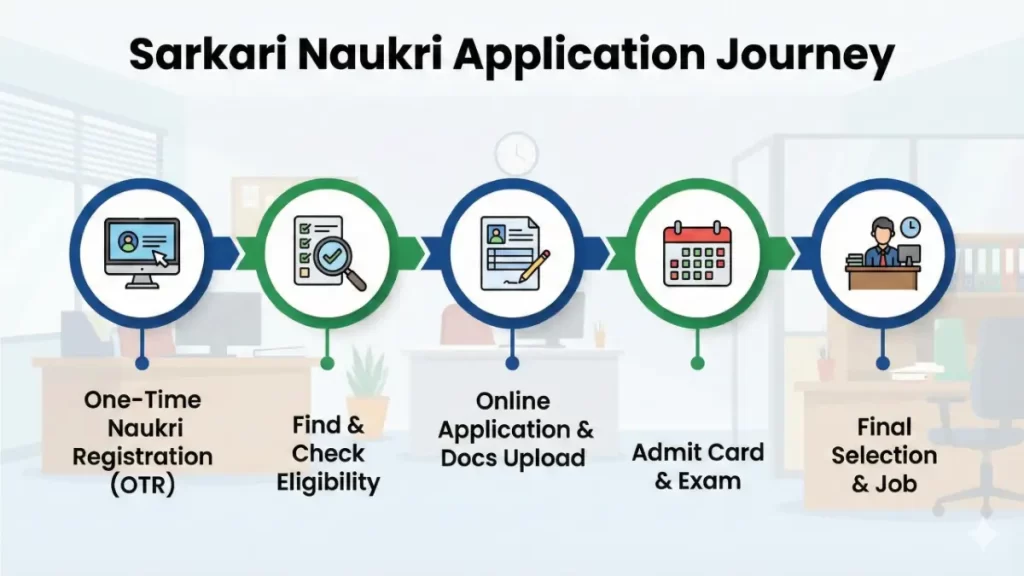
The Sarkari Naukri application process has evolved significantly in 2025. With the introduction of One-Time Registration (OTR) systems by major bodies like UPSC and SSC, the old methods of applying are no longer sufficient.
This comprehensive, expert-verified guide walks you through the modern application landscape. Whether you are aiming for an IAS position, a banking role, or a defense job, this step-by-step roadmap will ensure your application is accepted on the first try.
What is Sarkari Naukri? (And Why It’s Still the Best Choice)
Sarkari Naukri refers to permanent employment with the Central or State Government of India. Unlike the private sector, these roles offer a unique blend of job security, defined work hours, and long-term benefits.
Why Do Millions Apply?
-
Job Security: Layoffs are extremely rare in the government sector.
-
Financial Stability: Competitive salaries (under the 7th Pay Commission) with regular dearness allowance (DA) hikes.
-
Perks: Government housing, medical facilities (CGHS), and guaranteed pension (NPS/OPS depending on the state).
-
Social Status: Roles in ministries, PSUs, and administration command immense respect in society.
The New Era: Understanding One-Time Registration (OTR)
Expert Note: If you are applying in 2025 or 2026, you must know about OTR.
Major recruitment bodies, including the Union Public Service Commission (UPSC) and Staff Selection Commission (SSC), have shifted to a One-Time Registration system.
How OTR Works:
Instead of filling out your personal details (Name, Father’s Name, DOB, Education) for every single exam, you create a permanent profile once.
-
Register: You fill your data on the official portal once.
-
Get ID: You receive a unique OTR ID.
-
Apply Fast: When a new vacancy (like SSC CGL or UPSC CSE) is released, you simply log in, select the exam, and pay the fee. Your personal data is auto-fetched, saving time and reducing errors.
Pro Tip: Create your OTR profiles on
upsc.gov.inandssc.gov.inbefore a job notification is released to avoid server crashes on deadline days.
Prerequisites: The Ultimate Document Checklist
Before you open any application form, ensure you have the “Digital Stack” ready. Missing a single document or having a blurry scan is the #1 reason for rejection.
Essential Documents List
| Document Type | Specific Requirement |
| Proof of Identity | Aadhaar Card, Voter ID, PAN Card, or Passport (Must match application name exactly). |
| Date of Birth Proof | Class 10th Marksheet (Matriculation Certificate) is the standard proof. |
| Educational Certificates | 10th, 12th, Graduation Degree, and Consolidated Marksheets. |
| Caste Certificate | OBC-NCL, SC, ST, or EWS certificate (Must be issued within the valid financial year). |
| Photographs | Recent passport-size color photo (White background preferred). File size: usually 20kb–50kb. |
| Signature | Scanned signature in blue/black ink on white paper. File size: usually 10kb–20kb. |
Important: Keep scanned copies in both JPG and PDF formats. Many portals now require documents to be uploaded via DigiLocker.
Step-by-Step Guide to the Online Application Process
Follow this stepwise approach to navigate the Sarkari Naukri application process without stress.
Step 1: Finding Valid Job Vacancies
Do not rely on WhatsApp forwards. Trust only authoritative sources.
-
Official Portals:
upsc.gov.in,ssc.gov.in,ibps.in(for banks),indianrailways.gov.in. -
Aggregators: Employment News (Weekly Newspaper) or the National Career Service (NCS) portal.
-
Verification: Always download the official PDF Notification and read it thoroughly.
Step 2: Analyze Eligibility Criteria
Never apply blindly. Check the “Eligibility” section of the PDF for three things:
-
Age Limit: usually 18–30 years for general categories (relaxations apply for SC/ST/OBC).
-
Educational Qualification: Do you need a simple degree, or a specific percentage (e.g., 60% in B.Tech)?
-
Physical Standards: Jobs like Police, Army, or Railways often have height/vision requirements.
Step 3: Online Registration & Form Filling
-
Visit the recruitment portal linked in the notification.
-
Click on “Apply Online” or “New Registration”.
-
Enter basic details: Name, Email, Mobile Number. Ensure your mobile number is active as OTPs will be sent here.
-
Fill the Form: Enter your address, educational history, and exam center preferences carefully.
Step 4: Uploading Documents
This is the technical hurdle.
-
Use an online “Image Resizer” tool to adjust your Photo and Signature to the exact dimensions (e.g., 3.5cm x 4.5cm).
-
Ensure the images are not blurry. A blurry signature leads to instant rejection.
Step 5: Pay the Application Fee
-
Fee Range: ₹100 to ₹1000 (often free for Females/SC/ST).
-
Modes: UPI, Net Banking, Credit/Debit Card.
-
Caution: Do not refresh the page while the payment is processing.
Step 6: Final Submission & Printout
After payment, click “Final Submit.”
-
Immediate Action: Download the Application PDF and print two copies. You will need this document during the interview/document verification stage.
Post-Application: Admit Cards & Exam Strategy
Once the application is submitted, the wait begins.
-
Admit Card Release: usually 7–10 days before the exam date.
-
Download: Login using your Registration ID and Password to download the Hall Ticket.
-
Appear for the Exam: Most exams today are CBT (Computer Based Tests).
-
Stage 1: Prelims (Screening)
-
Stage 2: Mains (Subject Knowledge)
-
Stage 3: Interview or Skill Test (Typing/Physical)
-
Common Mistakes That Cause Rejection
Even smart candidates make these avoidable errors. Save your application by checking this list:
1. Waiting for the Last Date
Government servers are notorious for crashing on the final day due to high traffic.
-
Fix: Apply at least 5 days before the deadline.
2. Incorrect Category Selection
Selecting “OBC” or “EWS” without having a valid certificate issued before the cutoff date is a critical error.
-
Consequence: You will be disqualified even if you top the exam.
3. Name Mismatch
If your name is “Vinod Kumar Saini” on your Aadhaar card but “Vinod Saini” on your 10th Marksheet, this is a discrepancy.
-
Fix: Enter the name exactly as it appears on your 10th Class Marksheet.
4. Blurry Photos
Selfies or cropped group photos are not accepted.
-
Fix: Visit a studio or use a professional scanning app to ensure a white background and clear face visibility.
Expert Tips to Crack Sarkari Exams in 2025
Applying is easy; cracking the exam is the challenge. Here is how to stand out:
-
Master the Syllabus: Download the detailed syllabus from the notification. Don’t study “Maths”; study “Profit & Loss, Algebra, and DI” specifically.
-
Mock Tests are Non-Negotiable: Join a test series (like Testbook or Oliveboard). Attempting one mock test daily improves speed and accuracy.
-
Current Affairs: Read a standard newspaper (The Hindu or Indian Express) daily. General Awareness is the tie-breaker in most exams.
-
Analyze Previous Papers: 40% of questions in exams like SSC and Railways are based on previous years’ patterns.
Conclusion
Embarking on the journey of Sarkari Naukri is exciting, but it requires discipline from the very first click. By understanding the application process, respecting the eligibility criteria, and avoiding common documentation errors, you place yourself ahead of millions of casual applicants.
Remember, the application is the gateway. Treat it with the same seriousness as the exam itself. Follow this guide, stay updated with official notifications, and take that first confident step toward your dream government career.
Are you ready to apply? Check the latest notifications today!
Frequently Asked Questions (FAQs)
1. How can I get free job alerts for Sarkari Naukri in 2025?
To get reliable free job alerts, subscribe to the Employment News weekly gazette. Additionally, you can bookmark the “Recruitment” pages of official websites like upsc.gov.in and ssc.gov.in. Avoid paying for private job alert services; official information is always free.
2. What is the One-Time Registration (OTR) process?
OTR is a new initiative by bodies like UPSC and SSC. It allows you to register your personal details (Name, DOB, Parents’ Name) once and receive a unique ID. For future applications, you simply log in with this ID, and your form is auto-filled, saving time and preventing errors.
3. Can I apply for a government job if I am in my final year of graduation?
Yes, many exams (like UPSC Civil Services and IBPS PO) allow final-year students to apply provisionally. However, you must produce your final mark sheet/degree proof during the detailed application stage or interview, usually by a specific cutoff date mentioned in the notification.
4. What should I do if I make a mistake in my application form?
Most recruitment boards (like SSC and NTA) open a “Correction Window” for 2-3 days after the application period ends. You can modify specific fields (like photo or signature) by paying a nominal correction fee (usually ₹200-₹500). However, basic details like Name or Email are often non-editable, so be careful.
5. Is the Aadhaar Card mandatory for Sarkari Naukri applications?
While not always legally “mandatory,” providing an Aadhaar Card is highly recommended and often the easiest way to verify your identity. It streamlines the biometric verification process at the exam center. If you don’t have Aadhaar, you can usually use a Voter ID, Passport, or Driving License.
6. Why was my Sarkari Naukri application rejected?
The most common reasons for rejection include:
-
Blurry Photograph or Signature: The software cannot read the image.
-
Duplicate Applications: Submitting multiple forms for the same post.
-
Fee Payment Failure: The transaction failed, but the user didn’t verify the status.
-
Ineligible Age/Education: Applying despite not meeting the cutoff criteria.