
Last Updated on May 28, 2026 by Gaurav Kumar
Sarkari naukri in railways isn’t just a career choice in India — for millions of families, it represents security, dignity, and a future worth working toward. Every year, more than two crore people chase a few thousand seats. That number alone tells you how much this means to people.
Whether you passed your 10th boards last year, hold an engineering degree, or are a working professional looking for stability — Indian Railways has openings across every qualification level. But knowing about the openings is the easy part. Knowing exactly how to get there is what this guide covers.
Why Railway Jobs Still Top Every Government Job Wishlist
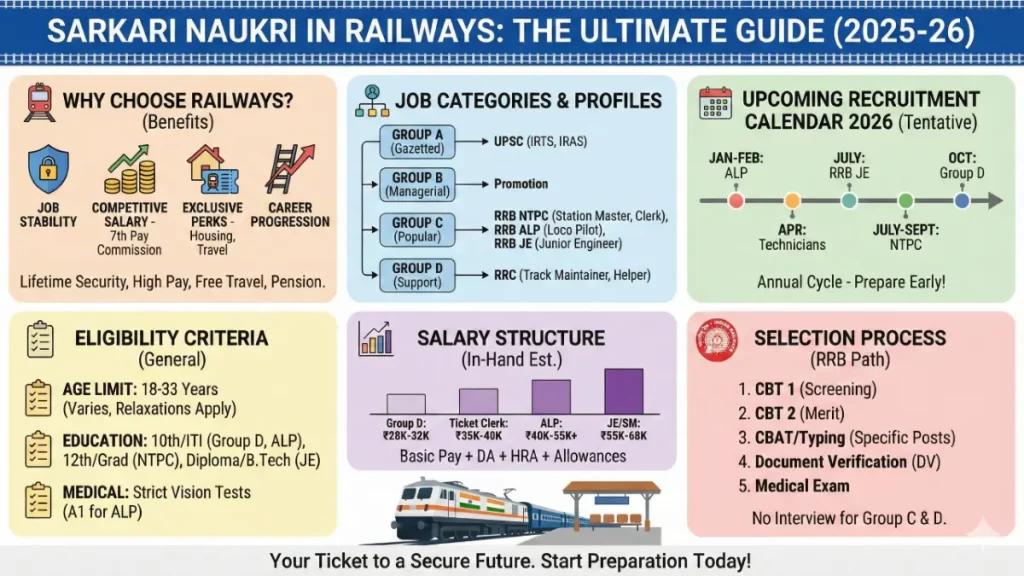
The appeal of railway jobs in 2026 goes beyond the salary. Yes, the pay is good. But what actually keeps people gunning for these seats year after year is the complete package.
Job security that private companies simply can’t match. Once you’re past probation, your employment stays intact until retirement. Market downturns, recessions, company restructuring — none of that applies here.
Salary backed by the 7th Pay Commission. Entry-level positions start at ₹18,000 basic pay and go up to ₹35,400 or higher for technical posts. Add Dearness Allowance (revised every six months), HRA based on city classification, and running allowances for operational roles — and your actual in-hand salary is often 35–40% above the basic figure.
Perks that genuinely change your standard of living:
- Free or heavily subsidised railway passes for you and your immediate family
- Medical care at Railway hospitals — no insurance premiums, no claim rejections
- Railway quarters or leased housing in most cities
- National Pension System (NPS) for post-retirement security
Room to grow. A Group D employee who clears the departmental exam (LDCE/GDCE) can move into supervisory roles. An ALP who puts in the years can become a Loco Inspector or Power Controller. The ladder exists — you just have to climb it.
Railway Job Categories — Which One Fits You?
Indian railway recruitment 2026 spans four broad groups. Understanding these helps you prepare for the right exam from day one.
Group A — Gazetted Officers
Recruitment happens through UPSC via Civil Services (CSE) and Engineering Services (ESE) exams. Roles include Indian Railway Traffic Service (IRTS) and Indian Railway Accounts Service (IRAS). These are high-responsibility management positions.
Group B — Promotions Only
Group B posts aren’t open for direct recruitment. They get filled through internal promotion from Group C — so this becomes relevant once you’re already in the system.
Group C — Where Most Aspirants Aim
This is the heart of RRB recruitment 2026. The Railway Recruitment Board manages hiring across 21 regional boards for roles including:
- RRB NTPC: Station Master, Goods Guard, Junior Clerk, Commercial Apprentice, Ticket Clerk
- RRB ALP: Assistant Loco Pilot — the people who drive the trains
- RRB JE: Junior Engineer for civil, electrical, and signal & telecom departments
- Technicians: Maintenance staff across electrical and mechanical departments
Group D (Level 1) — Entry Point for 10th Pass Candidates
Managed by Railway Recruitment Cells (RRC), Railway Group D recruitment 2026 covers Track Maintainer, Pointsman, Workshop Assistant, and Hospital Attendant roles. This is the primary pathway for sarkari naukri in railway for 10th pass candidates.
RRB Recruitment 2026 — Tentative Exam Calendar
The Ministry of Railways now follows an annual calendar, which means you can plan your preparation well before any notification drops. Here’s the expected schedule for upcoming railway jobs 2026:
Don’t wait for the official notification before opening your books. The pattern is consistent enough to start preparation months in advance — and early starters consistently outperform last-minute crammers.
Railway Job Eligibility Criteria — Know Before You Apply
Getting rejected at the application stage is more common than people expect, simply because candidates miss eligibility details.
Age Limit for Railway Jobs — General Category
- Railway Group D: 18 to 33 years
- ALP and Technicians: 18 to 30 years
- NTPC Undergraduate posts: 18 to 30 years
- NTPC Graduate posts: 18 to 33 years
- Junior Engineer (JE): 18 to 33 years
Age relaxation applies: OBC (Non-Creamy Layer) gets 3 years, SC/ST gets 5 years, and PwBD candidates get 10 years of additional relaxation.
Educational Qualifications — Every Level Has an Opening
Upcoming railway jobs 2026 for 12th pass candidates are primarily in the NTPC category. If you’ve just finished your 12th, this is the natural first target.
Medical Fitness Standards — The Part People Underestimate
Railway medical tests are stricter than most candidates expect, especially for operational roles.
- A1 Category (ALP): 6/6 vision without glasses is mandatory. Colour blindness is disqualifying.
- B1/B2 (Station Master, Goods Guard): Some visual correction is allowed within defined limits.
- C1 and below (Clerical roles): More relaxed vision standards apply.
Get your eyes tested early. If you’re targeting ALP, know your medical category well before investing years of preparation into it.
Railway Salary Structure 2026 — What You Actually Take Home
The gross salary figure people quote rarely tells the full story. Here’s a realistic picture under the 7th Pay Commission:
ALP salaries look higher because of running allowances — hours spent driving trains count as additional pay. For a senior ALP on busy routes, monthly take-home often crosses ₹55,000 comfortably.
The Selection Process — What Happens After You Apply
Most RRB exams follow a similar multi-stage process. Here’s how it works for NTPC, Group D, and ALP:
Stage 1 — CBT 1 (Computer Based Test)
This is the screening round. 100 questions across Maths, Reasoning, and General Awareness in 90 minutes. The cutoff here determines who moves forward.
Stage 2 — CBT 2 (Mains)
Higher difficulty, more subject-specific. This is where merit gets separated from average performance.
Stage 3 — Skill or Aptitude Tests
-
CBAT (Psycho Test): Only for ALP and Station Master candidates — tests reaction time, spatial awareness, and focus under pressure
-
Typing Test: Required for Clerk and Typist posts
Stage 4 — Document Verification
Your 10th and 12th mark sheets, caste certificate, ID proof, and photos get physically verified. Spelling mismatches between your application and your certificates cause disqualification here — so check every detail before submitting your form.
Stage 5 — Medical Examination
The final gate. Your post determines your medical category, and the tests are thorough.
How to Apply for Railway Jobs Online in 2026
The entire application process is now digital. Here’s what a clean, rejection-free application looks like:
- Identify your RRB zone — India has 21 regional Railway Recruitment Boards. Apply to the board covering the region where you’re comfortable working long-term.
- Complete One-Time Registration (OTR) — Visit the official recruitment portal rrbapply.gov.in or your regional RRB site to complete your One-Time Registration. Register using your Aadhaar card and mobile number.
- Fill the application form carefully — Your name must match your 10th mark sheet exactly, including middle names and initials.
- Upload documents correctly — Passport photo with a light background, clear signature, and legible certificate scans.
- Pay the application fee:
-
- General/OBC: ₹500 (₹400 refunded, minus bank charges, after appearing for the CBT 1 exam)
- SC/ST/Female/Ex-Servicemen: ₹250 (fully refunded after appearing for the exam)
Note: Many candidates receive ₹390 instead of ₹400 at refund — this is normal. Banks deduct a small transaction charge, so don’t panic when you see the slightly reduced amount.
-
Download and save your confirmation receipt — Many candidates skip this step and face avoidable problems during Document Verification later.
Railway Exam Preparation — Practical Strategy That Works
The railway exam syllabus covers predictable topics. What separates toppers from the rest is execution, not just information.
For Group D and ALP — Science is Non-Negotiable
NCERT Science textbooks for Classes 9 and 10 cover the bulk of what appears in Level 1 exams. Physics, Chemistry, and Biology questions from this range appear consistently across RRB papers. Don’t skip them in favour of only doing mock tests.
Reasoning — Your Fastest Score-Booster
Syllogism, coding-decoding, blood relations, and number series are high-yield topics. Thirty minutes of daily reasoning practice builds the speed you need in CBT 1, where every second counts.
Current Affairs — Stay Railway-Focused
General Awareness questions in 2026 will likely cover Vande Bharat expansion, new railway budget allocations, station redevelopment projects, and freight corridor updates. Don’t just read the news — understand how railway policy connects to it.
Mock Tests — Weekly, Not Monthly
At least one full-length mock test per week from six months out. The analysis after each mock matters more than the score itself. Where did you lose time? Which topics cost you marks? Fix those patterns before the actual exam.
Best Books for Railway Exam Preparation 2026
- Maths: Fast Track Objective Arithmetic — Rajesh Verma
- Reasoning: A Modern Approach to Verbal and Non-Verbal Reasoning — R.S. Aggarwal
- General Science: NCERT Class 9 & 10 (Physics, Chemistry, Biology)
- General Awareness: Lucent’s General Knowledge + a current affairs monthly covering the last 12 months before your exam
What’s New in Railway Recruitment — 2026 Trends
Bigger Vacancy Numbers Expected This Cycle
Indian Railways plans to fill over one lakh vacancies across various categories in the 2025–26 recruitment cycle, with Group D and NTPC making up the bulk. After the mega drives of recent years, a fresh cycle is underway — and this time with clearer timelines and a more structured notification calendar.
Digital Exam Centres Now Reaching Tier 3 Cities
RRB has been steadily expanding its CBT infrastructure beyond metros. For aspirants in smaller towns and districts, this means less travel, lower costs, and fairer access — a genuinely meaningful shift for candidates who previously had to travel 200+ km just to sit an exam.
Apprenticeship-to-Job Pipeline Is Growing
Railway workshops and production units have started connecting their apprenticeship programmes more directly to Group C and D vacancies. If you’re an ITI holder currently serving a railway apprenticeship, stay alert to departmental vacancy notifications — this pipeline is expanding and worth watching.
Frequently Asked Questions — Sarkari Naukri in Railways 2026
Q1. What is the minimum qualification for upcoming railway jobs 2026, and can a 10th pass student apply?
Yes, 10th pass candidates can apply directly for Railway Group D Level 1 posts like Track Maintainer and Pointsman. For ALP, an ITI certificate in a relevant trade is mandatory alongside the 10th pass. NTPC undergraduate posts require a 12th pass certificate as the minimum qualification.
Q2. How can I apply for railway jobs online in 2026, and which website should I use?
Visit the official recruitment portal rrbapply.gov.in or your regional RRB website to complete One-Time Registration. After registration, fill the application form, upload your photograph and signature, and pay the fee online. Always download and save your confirmation receipt after submission.
Q3. What is the age limit for railway jobs in 2026 under the General category?
General category candidates must be between 18 and 33 years for NTPC Graduate and Group D posts, and 18 to 30 years for ALP and NTPC Undergraduate posts. OBC candidates get 3 additional years, SC/ST candidates get 5 years, and PwBD candidates get 10 years of relaxation.
Q4. What are the best books for railway exam preparation in 2026 for a first-time aspirant?
Start with NCERT Science Classes 9 and 10 for General Science, R.S. Aggarwal for Reasoning, and Rajesh Verma’s Fast Track Arithmetic for Maths. For General Awareness, combine Lucent’s GK with a current affairs monthly covering the 12 months leading up to your exam date.
Q5. What does the railway medical fitness test check, and can candidates with spectacles apply?
The medical test checks vision, colour perception, hearing, and general fitness based on your specific post. Candidates with spectacles can apply for most clerical and non-driving posts. ALP requires 6/6 vision without glasses — colour blindness is a disqualifying condition for that particular role.
For official notifications, railway recruitment 2026 notification PDF downloads, and railway exam syllabus PDFs, visit the official recruitment portal at rrbapply.gov.in or your regional RRB portal directly.