
Every year, thousands of eligible families miss out on Sarkari Yojana benefits worth thousands of rupees — not because they don’t qualify, but because they never find the right scheme in time. That’s the real problem with government scheme information in India: it’s scattered across dozens of ministry websites, none of which talk to each other.
Answering “which Sarkari Yojana am I eligible for” is genuinely hard because eligibility rules change mid-year, new schemes launch quietly, and old ones get merged or renamed. By the end of this guide, you’ll know exactly which central and state schemes are active in 2026, what documents you need, and how to avoid the three mistakes that get most applications rejected.
Why Sarkari Yojana Information Goes Outdated So Fast
Government schemes aren’t static. Budgets get revised every February, and ministries tweak eligibility criteria almost every quarter.
Take Ayushman Bharat PM-JAY as an example. It once covered only families listed under SECC 2011 data. Then the government expanded it to cover every citizen aged 70 and above, regardless of income — a change that added crores of new beneficiaries overnight.
PM Awas Yojana went through a similar shift. PMAY 2.0 now applies stricter income, property, and family-composition rules before approving the interest subsidy on home loans.
This is exactly why a “Sarkari Yojana list” written even eight months ago can mislead readers today. Schemes get renamed, merged, or moved into what officials now call “saturation mode” — a push to ensure every eligible citizen is actually enrolled, not just aware.
The Shift Toward Saturation, Not Just Announcement
In 2026, the government’s focus moved from announcing new schemes to closing the gap between eligible citizens and actual enrolment. The Viksit Bharat Sankalp Yatra drive exists for exactly this reason — reaching people who qualify but never applied.
If you assumed you’re “probably not eligible” for a scheme without checking this year’s criteria, you’re not alone. That assumption costs families real money.
Also Read This: Current Affairs Today 2026
Sarkari Yojana List 2026: Category-Wise Breakdown
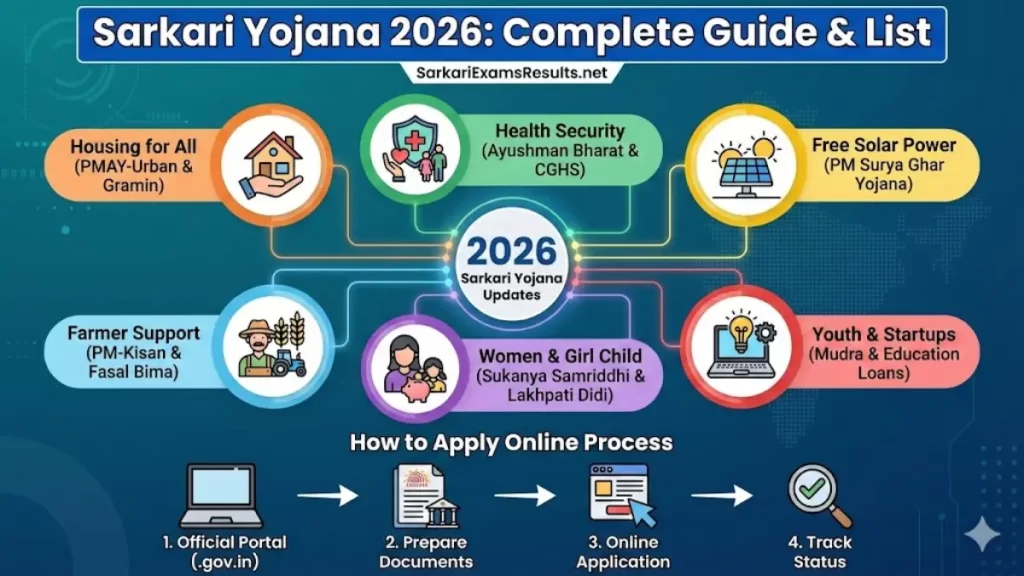
Government schemes fall into four broad buckets: income support, health and insurance, housing, and education or skill development. Here’s what’s active right now, with real numbers.
Farmers and agriculture:
PM-KISAN Samman Nidhi still delivers ₹6,000 a year in three installments to landholding farmer families. The 23rd installment was released in June 2026, and eKYC is now mandatory — including biometric verification — before the next payout reaches your account.
A newer addition, PM Dhan-Dhaanya Krishi Yojana, launched alongside the Dalhan Atmanirbharata Mission with a combined outlay of ₹35,440 crore, aimed at boosting pulse production and reducing import dependence.
Health and insurance:
Ayushman Bharat PM-JAY offers ₹5 lakh in annual health cover per family. Coverage for senior citizens above 70 now applies regardless of income bracket — a genuinely useful expansion if you have elderly parents at home.
Housing:
PMAY 2.0’s subsidy depends on three factors: your household income slab, whether you already own a pucca house, and your family size. Rural and urban applicants face different documentation checklists, so confirm which track applies before you apply.
Energy and household savings:
PM Surya Ghar Muft Bijli Yojana crossed 16,000 rooftop solar installations per day by July 2026. Households get up to 300 units of free electricity monthly after installing a subsidized solar unit — a scheme worth checking even if you’re not thinking “government scheme” when you think “solar panel.”
Education and Scholarship Schemes You Shouldn’t Skip
If you’re a student, parent, or counselor, this is the section that affects you most directly.
The National Scholarship Portal (NSP) is open for the 2026-27 academic year, with student applications closing October 31, 2026, and institute verification by November 15. Multiple central schemes route through this single portal, which is why checking it once covers dozens of scholarship options.
PM Yasasvi Scholarship, run by the Ministry of Social Justice and Empowerment, targets students from families earning under ₹2.5 lakh annually. It’s merit-based, so grades matter as much as income proof.
PMEGP (Prime Minister’s Employment Generation Programme) isn’t a scholarship, but it matters for education aspirants planning vocational routes — it offers a loan subsidy up to ₹25 lakh for anyone 18 or older who has passed the 8th grade and wants to start a business instead of chasing a degree.
Also Read This: Government Jobs in India: Unlocking Opportunities for a Secure Future
Central vs State Schemes: What Actually Changes for You
A common confusion: people assume central schemes always pay more or matter more than state ones. That’s not true — it depends entirely on where you live.
| Factor | Central Schemes | State Schemes |
|---|---|---|
| Funding source | Union Budget (e.g., PM-KISAN, PMAY, PM-JAY) | State budget, varies by state |
| Eligibility uniformity | Same rules pan-India | Differs by state government |
| Example | Ayushman Bharat (₹5 lakh cover nationwide) | Maharashtra’s Ladki Bahin Yojana (₹1,500/month for women 21-65) |
| Where to apply | Central scheme portals (pmkisan.gov.in, pmjay.gov.in) | State government scheme portals |
Here’s a detail most guides miss: some state schemes stack on top of central ones. A woman farmer in a state running its own top-up scheme could receive both PM-KISAN’s ₹6,000 and a state-level cash transfer in the same year — the two aren’t mutually exclusive unless a scheme’s rules say so explicitly.
Why “One Scheme Fits All” Advice Fails
Counselors and parents often search for a single master list, expecting one clear answer. Real eligibility depends on your state, income bracket, occupation, gender, age, and sometimes caste category — all at once.
That’s why checking eligibility directly on the official portal for each scheme beats relying on any static blog list, including this one.
How to Apply for Sarkari Yojana in 2026: Step-by-Step
Most rejections happen for avoidable reasons — mismatched Aadhaar details, missing eKYC, or applying under the wrong income category. Here’s how to avoid that.
- Identify your category first. Are you applying as a farmer, student, homeowner, or entrepreneur? Each category has a different lead scheme.
- Complete eKYC before anything else. PM-KISAN, PM-JAY, and most DBT schemes now reject applications without biometric or OTP-based eKYC.
- Match your documents to the scheme’s specific list. Income certificates, land records, and caste certificates all have different validity periods.
- Apply only through official .gov.in portals. Third-party “agents” charging fees for free government schemes are a common scam — no legitimate Sarkari Yojana charges an application fee.
- Track your application status monthly. Portals like PM-KISAN’s “Know Your Status” and the PMAY CLSS Awas Portal let you check progress without visiting an office.
Want a shortcut? Bookmark our Sarkari Yojna updates hub — we track scheme changes as they’re announced, so you’re not relying on outdated PDFs floating around WhatsApp groups.
Common Mistakes That Delay Approval
Applying under an outdated income slab is the single biggest cause of rejection this year, since several schemes revised their thresholds in the 2026-27 budget cycle.
Skipping bank account seeding with Aadhaar is the second-biggest issue — DBT transfers fail silently if this step is incomplete, and you won’t get a rejection notice, just no payment.
Conclusion
Sarkari Yojana 2026 isn’t about one giant list — it’s about matching your specific situation to the right central or state scheme before deadlines close. Farmers, students, women, homeowners, and entrepreneurs each have distinct schemes with real financial value, from PM-KISAN’s ₹6,000 annual support to PMAY’s housing subsidy and NSP’s education scholarships.
The schemes that pay off are the ones you actually apply for, correctly and on time — not the ones you bookmark and forget. Check your eligibility on the official portal for your category today, and if you’re unsure where to start, browse our government schemes and exam updates for the latest verified information.
Frequently Asked Questions
What is Sarkari Yojana 2026?
Sarkari Yojana refers to welfare schemes launched by the central and state governments of India, covering farmers, students, women, and homeowners. In 2026, the focus has shifted toward saturation — ensuring every eligible citizen actually enrolls, not just new scheme announcements.
How do I check my eligibility for a government scheme?
Visit the specific scheme’s official portal (like pmkisan.gov.in or pmjay.gov.in) and use their eligibility checker tool. Eligibility depends on income, state, occupation, and age, so no single list applies to everyone.
Is PM-KISAN still active in 2026?
Yes, PM-KISAN remains active, with the 23rd installment released in June 2026. Farmers must complete mandatory eKYC, including biometric verification, to receive future installments without delay.
Do I need to pay any fee to apply for a Sarkari Yojana?
No legitimate government scheme charges an application fee. If anyone asks for payment to process your Sarkari Yojana application, it’s a scam — apply only through official .gov.in portals.
Which government scheme helps with education expenses?
The National Scholarship Portal (NSP) covers multiple central scholarship schemes for the 2026-27 academic year, with applications closing October 31, 2026. PM Yasasvi Scholarship specifically targets students from families earning under ₹2.5 lakh annually.
Can I get benefits from both a central and a state scheme together?
Yes, in most cases. Central and state schemes usually aren’t mutually exclusive unless a scheme explicitly states otherwise, so check both levels for your state.