
Last Updated on August 12, 2026 by Gaurav Kumar
Most MBA and PGDM graduates immediately think private sector — consulting firms, MNCs, startups. But here’s what a surprisingly large number of management graduates miss completely.
Some of the most stable, well-paying, and respected careers in India sit firmly in the government sector — and your management degree makes you a strong candidate for them.
Top government jobs after an MBA or PGDM aren’t just possible — they’re actively designed for candidates with management training, analytical thinking, and leadership skills.
In this post, you’ll discover exactly which government roles are open to management graduates, what the selection process looks like, how your PGDM specializations or MBA specializations give you an edge, and what job opportunities after PG you should seriously consider if stability and impact matter to you.
Whether you’re a student weighing your options or a parent who’d sleep better knowing your child has a government career on the table — read on.
Why Management Graduates Are a Strong Fit for Government Jobs
Let’s address the misconception first — government jobs aren’t just for arts graduates or civil services aspirants with a history background.
Modern India’s government sector is actively looking for people with business acumen, data skills, financial knowledge, and strategic thinking. That’s exactly what a good MBA or PGDM program builds.
What Your Management Degree Brings to Government Roles
-
Analytical thinking — Government policy, public finance, and regulatory work requires the same data-driven decision making that PGDM programs teach
-
Financial literacy — Roles in RBI, NABARD, and public sector banks demand a strong understanding of economics, banking, and finance
-
Management and leadership skills — Government organizations need trained managers, not just administrators
-
Quantitative ability — Many government entrance exams test the same quantitative and logical reasoning skills sharpened during MBA and PGDM preparation
-
Specialization advantage — Specific PGDM specializations like Finance, HR, Marketing, and Analytics align directly with government job profiles
The overlap between what your management degree builds and what government employers need is far bigger than most students realize.
Top Government Jobs After MBA and PGDM — By Category
Here’s a structured breakdown of the best top government jobs after PGDM and MBA in India — organized by sector so you can match them to your specialization:
Banking and Financial Sector
These are among the most popular job opportunities after PG in management for good reason — strong pay, job security, and clear career growth.
Reserve Bank of India (RBI) — Grade B Officer
RBI Grade B is one of the most prestigious top government jobs after MBA in India. The role covers monetary policy, financial regulation, and economic research. The exam tests Economics, Finance, Management, and English — all areas where MBA and PGDM graduates have a clear advantage.
Eligibility: Graduation with 60% marks. MBA/PGDM holders get direct application eligibility in many cases.
Salary: ₹35,000–₹40,000 basic + allowances. CTC easily crosses ₹12–14 LPA.
8th Pay Commission Note: With the 8th Pay Commission discussions active in 2026, RBI and other government roles are expected to see upward pay revisions — making these roles even more financially attractive in the near term.
NABARD — Grade A and B Officers
NABARD (National Bank for Agriculture and Rural Development) recruits management graduates for development banking, rural finance, and agricultural policy roles. If your PGDM Finance specialization is your strength, NABARD is a natural fit.
Salary: ₹28,000–₹44,500 basic + allowances. CTC around ₹10–14 LPA.
Public Sector Bank PO (SBI, Bank of Baroda, PNB)
Bank PO roles remain one of the most accessible entry points into top government jobs after PGDM. MBA and PGDM Finance graduates often perform strongly in the IBPS PO and SBI PO exams due to their financial and quantitative training.
Salary: ₹27,000–₹35,000 basic + allowances. CTC around ₹8–11 LPA.
Preparing for government banking exams after your management degree? Start with a mock test today to benchmark your current level — most RBI and NABARD toppers begin preparation at least 12 months before the exam.
Insurance and Investment Sector
LIC — Assistant Administrative Officer (AAO)
LIC AAO is one of the most stable and well-regarded top government jobs for management graduates. The role involves insurance operations, actuarial support, and financial analysis. PGDM Finance and MBA Finance graduates are particularly well-suited.
Salary: ₹32,000–₹36,000 basic + allowances. CTC around ₹10–12 LPA.
8th Pay Commission Note: LIC and other insurance PSUs fall under the 8th Pay Commission review scope — current discussions suggest meaningful pay band revisions that could push entry-level CTC closer to ₹14–15 LPA post-revision.
SEBI — Grade A Officer
SEBI (Securities and Exchange Board of India) is the regulator for India’s capital markets — and one of the most intellectually stimulating top government jobs after MBA in Finance. The role demands deep financial market knowledge, which PGDM Finance specialization directly builds.
Salary: ₹28,000–₹34,250 basic + allowances. CTC around ₹15–17 LPA with benefits.
From PGDM to RBI or SEBI — Your Step-by-Step Path
Here’s a visual flowchart showing exactly how a management graduate moves from PGDM enrollment to landing a role at India’s top financial regulators:
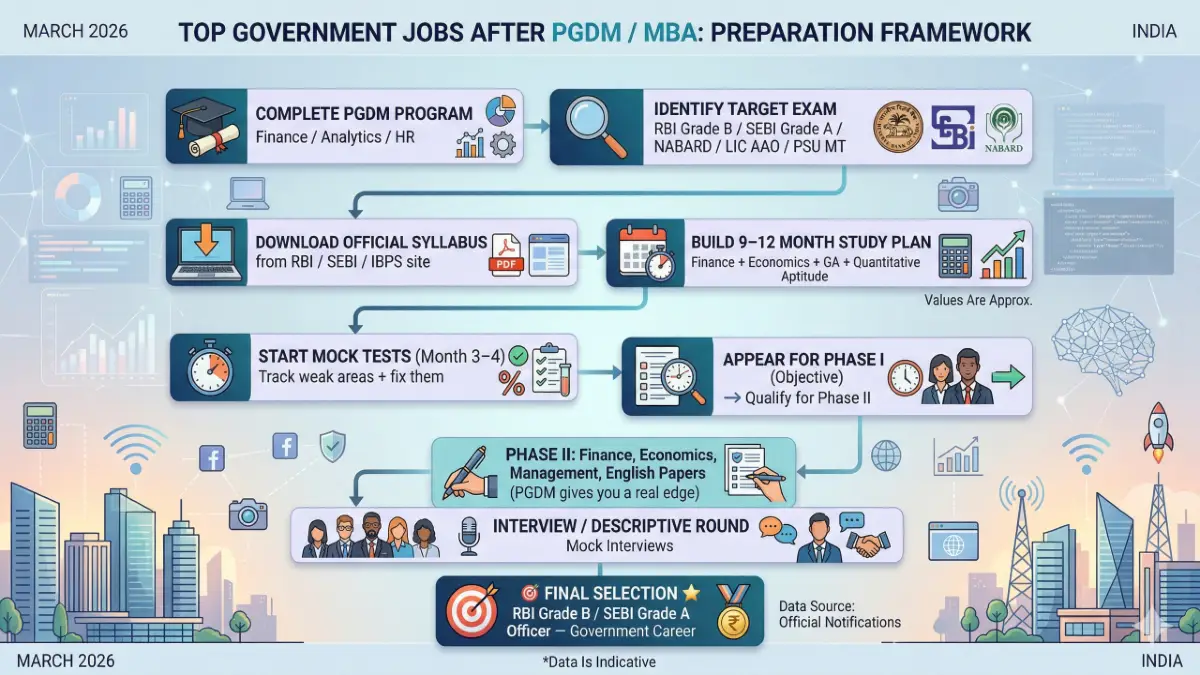
This path is realistic and achievable — thousands of PGDM graduates clear these exams every year. The key is starting early and staying consistent.
Management and Administrative Services
Indian Economic Service (IES)
IES is one of the premier civil services for graduates with economics and management backgrounds. Officers work directly with economic policy-making at the central government level. If your MBA specializations include Economics or Finance, IES is worth serious consideration.
Eligibility: Postgraduate degree in Economics, Statistics, or related fields. MBA/PGDM with Economics focus qualifies in many cases.
Salary: ₹15,600–₹67,000 depending on grade + allowances. 8th Pay Commission revisions expected to push entry-level figures notably higher.
Union Public Service Commission (UPSC) — Civil Services
The IAS, IPS, and IFS remain the gold standard among top government jobs in India. Many successful IAS officers come from management backgrounds. Your PGDM or MBA training gives you a strong edge in General Studies Paper II (Governance, Policy, Management) and the Essay paper.
Salary: IAS — ₹56,100 basic at entry + allowances, housing, and perks. With the 8th Pay Commission review underway in 2026, IAS entry-level basic pay is widely expected to see a significant upward revision — early estimates suggest figures crossing ₹70,000–₹75,000 basic at entry level post-revision.
State Public Service Commissions
Every state has its own PSC conducting State Civil Service exams. Many state-level government management roles — including District Industry Centres, State Finance Corporations, and Development Authorities — actively recruit MBA and PGDM graduates.
Public Sector Undertakings (PSUs)
ONGC, NTPC, BHEL, GAIL, SAIL — Management Trainee Roles
Major PSUs conduct their own management trainee recruitment exams or recruit through GATE (for technical roles) and separate management recruitment drives. These are among the best job opportunities after PG for PGDM graduates who want the stability of a government organization with the culture of a large corporate.
Common roles: HR Management Trainee, Finance MT, Marketing MT, Operations MT
Salary: ₹40,000–₹60,000 basic + perks. CTC often ₹12–18 LPA at entry level.
8th Pay Commission Note: PSU pay scales are linked to central government pay structures. The 8th Pay Commission revisions — actively discussed through 2025–26 — are expected to benefit PSU employees meaningfully, particularly at entry and junior levels.
Roles That Match Your PGDM Specializations in PSUs:
PSU roles combine government-level job security with compensation structures that match — and sometimes beat — private sector mid-tier companies.
Defence and Strategic Roles
Indian Defence Accounts Service (IDAS)
IDAS officers manage financial accounts and budget operations across India’s defence establishments. PGDM Finance graduates bring strong analytical preparation for this role.
Defence Research and Development Organisation (DRDO) — Management Roles
DRDO recruits management graduates for administrative, HR, and finance functions supporting India’s defence research ecosystem. A genuinely unique environment for PGDM HR and Finance graduates who want to contribute to national security.
Not sure which government exam suits your PGDM or MBA specialization best? Map your specialization against the roles above and pick 2–3 that align — then build a focused preparation plan instead of spreading yourself thin.
How to Prepare for Top Government Jobs After Your Management Degree
Here’s the honest truth — you can’t crack RBI Grade B or SEBI Grade A without dedicated preparation. Your management degree gives you an edge, but the exam still needs focused study.
A Realistic Preparation Framework
Step 1: Choose your target exam early
Don’t try to prepare for five exams simultaneously. Pick 2–3 that align with your PGDM specializations or MBA specializations and go deep.
Step 2: Understand the exam pattern
RBI Grade B, NABARD, SEBI, and SBI PO all have different patterns. Download official syllabi from each organization’s website and build your study plan around the actual exam structure.
Step 3: Build on your management foundation
Your PGDM or MBA already covered Quantitative Aptitude, Financial Management, Economics, and HR — all tested in government management exams. Revise these with exam-specific mock tests.
Step 4: Stay current on economic and financial news
RBI Grade B, SEBI, and NABARD exams heavily test current affairs related to the Indian economy, monetary policy, and financial markets. Follow RBI bulletins, Economic Survey summaries, and quality financial newspapers daily. In 2026, 8th Pay Commission developments and monetary policy decisions are particularly relevant current affairs topics.
Step 5: Start mock tests early
Begin full-length mock tests at least 4–6 months before your exam date. This is non-negotiable for competitive government exams.
Conclusion
A management degree doesn’t lock you into the private sector. In fact, some of the most rewarding top government jobs in India are actively designed for people with exactly the skills your MBA or PGDM built.
From RBI Grade B and SEBI to PSU Management Trainee roles and UPSC Civil Services — the range of top government jobs after PGDM and MBA is wider than most candidates realize.
And with the 8th Pay Commission review actively underway in 2026, government compensation packages across RBI, SEBI, PSUs, and civil services are poised for meaningful upward revisions — making this an even better time to pursue a government career after your management degree.
The key is matching your PGDM specializations or MBA specializations to the right exam, starting preparation early, and treating the government exam process with the same seriousness you’d give a corporate placement interview.
Your management degree is already an asset. Now it’s about pointing it in the right direction.
Ready to explore government job opportunities after your management degree? Start by identifying your top two target exams today, download the official syllabi, and build your preparation calendar — your government career is closer than you think.
Frequently Asked Questions (FAQs)
1. Which are the top government jobs after MBA or PGDM in India?
The most sought-after top government jobs after PGDM and MBA include RBI Grade B Officer, SEBI Grade A Officer, NABARD Grade A/B, LIC AAO, SBI PO, PSU Management Trainee roles (ONGC, NTPC, BHEL, GAIL), and UPSC Civil Services. Each offers strong compensation, job security, and long-term career growth — and with 8th Pay Commission revisions expected in 2026, the financial case for these roles is stronger than ever.
2. Do PGDM specializations affect which government jobs I can apply for?
Yes — significantly. Finance specializations align with RBI, SEBI, NABARD, and LIC AAO roles. HR specializations fit PSU HR Management Trainee positions. Marketing specializations open doors to PSU marketing roles at companies like IOCL and GAIL. Matching your PGDM specializations to the right exam gives you both eligibility and a preparation advantage.
3. Is a PGDM equivalent to an MBA for government job eligibility?
For most government job applications — including PSU recruitment, bank PO exams, and RBI Grade B — PGDM from an AICTE-approved institute is treated on par with an MBA. However, always verify the specific eligibility criteria for each exam directly on the official recruitment notification, as requirements can vary.
4. What is the salary range for top government jobs after management degrees?
Salaries vary by role and organization. RBI Grade B and SEBI Grade A officers earn CTC of ₹12–17 LPA with benefits. PSU Management Trainees typically earn ₹12–18 LPA CTC. SBI PO and Bank PO roles start around ₹8–11 LPA. With 8th Pay Commission revisions actively under discussion in 2026, these figures are expected to see upward revision — making government roles more financially competitive with private sector alternatives.
5. How long does it take to prepare for RBI Grade B after a PGDM?
Most serious candidates dedicate 9–12 months of focused preparation for RBI Grade B. PGDM graduates have an advantage in Phase II (Finance, Management, Economics papers), but Phase I (objective) requires consistent practice with mock tests and current affairs. Starting preparation in your final semester of PGDM is the smartest approach.
6. Can I apply for UPSC Civil Services after completing a PGDM?
Yes. PGDM from an AICTE-approved institute qualifies as a graduation-equivalent for UPSC Civil Services eligibility in most cases — though you should verify this against the current UPSC notification. Many successful IAS officers come from management backgrounds, and PGDM training is particularly useful for General Studies Paper II and the Management optional subject.