
Last Updated on March 14, 2026 by Bharat
Everyone talks about cracking CAT, getting into a PGDM program, and landing a high-paying private sector job. But here’s what most management students don’t consider seriously enough.
Some of the most financially rewarding, stable, and genuinely fulfilling careers for management graduates sit inside India’s Public Sector Undertakings — and most students walk right past them.
PSU jobs for management graduates offer something the private sector rarely can — job security, structured salary growth, world-class perks, and the chance to work on projects that actually shape India’s infrastructure, energy, and economy.
In this post, you’ll get a clear, honest breakdown of PSU salary structures, actual job roles available to management graduates, the perks that most people underestimate, career growth timelines, and how your PGDM programs specialization affects which PSU doors open for you.
Let’s get into it.
- Why PSU Jobs Deserve Serious Attention from Management Graduates
- What Makes PSUs Genuinely Attractive in 2026
- PSU Job Roles Available to Management Graduates
- Management Trainee — The Primary Entry Route
- Functional Roles by PGDM Specialization
- PSU Salary Structure — What You Actually Take Home
- Entry-Level Management Trainee Salary (E1/E2 Grade)
- Understanding the Pay Structure
- PSU Perks — The Part Most Students Underestimate
- Perks That Add Real Financial Value
- The Real Value Comparison
- Career Growth in PSUs — The Stairway to Success
- Fast-Track Opportunities in PSUs
- Delhi NCR Students: You Have a Built-In Location Advantage
- Major PSU Offices in Delhi NCR
- Why This Matters for PGDM Students
- Conclusion
- Frequently Asked Questions (FAQs)
Why PSU Jobs Deserve Serious Attention from Management Graduates
Here’s the honest truth — PSU jobs have an image problem among management students. They’re often dismissed as “slow” or “bureaucratic” compared to the fast pace of startup culture or consulting.
But that perception is increasingly outdated.
Today’s major PSUs — ONGC, NTPC, BHEL, GAIL, IOCL, SAIL, and others — operate like large professional organizations with structured HR systems, performance-linked incentives, international operations, and management hierarchies that rival private sector corporations.
What Makes PSUs Genuinely Attractive in 2026
-
Job security — PSU employment is among the most stable career paths in India. Economic downturns, market volatility, and industry disruptions rarely threaten PSU positions the way they affect private sector roles
-
8th Pay Commission tailwinds — With the 8th Pay Commission review actively underway in 2026, PSU pay scales linked to central government structures are expected to see meaningful upward revisions
-
Structured career progression — You know exactly what the next 5, 10, and 15 years look like — with clear promotion timelines and grade-linked pay increases
-
Perks that add significant real value — Housing, medical coverage, provident fund, gratuity, and pension add 30–50% to the financial value of a PSU package beyond the basic salary
-
Work-life balance — Compared to the demanding hours of consulting or investment banking, PSU roles typically offer significantly better personal time
-
Delhi NCR location advantage — If you study or live in Delhi NCR, you’re already sitting next to some of India’s most important PSU corporate headquarters (more on this below)
For parents evaluating long-term security for their child’s career — PSU jobs deliver a combination of financial stability and personal wellbeing that very few private sector roles can match at the same experience level.
PSU Job Roles Available to Management Graduates
This is where career opportunities for PGDM in PSUs get specific. PSUs recruit management graduates into defined functional management tracks that align directly with your specialization — not generic administrative positions.
Management Trainee — The Primary Entry Route
The Management Trainee (MT) program is the standard entry point for fresh management graduates into PSUs. Most major PSUs recruit MTs through dedicated written exams, followed by group discussions and interviews.
Here’s what the MT role looks like in practice:
-
Duration of training: Typically 1 year of structured on-the-job training across different departments
-
Posting: You get placed in a functional department aligned with your specialization — Finance MT goes to Finance, HR MT goes to Human Resources
-
Responsibilities: Data analysis, report preparation, project support, vendor management, team coordination — real work from day one
-
Confirmation: After successful completion of the training year, you get confirmed into an executive-level position
Functional Roles by PGDM Specialization
Here’s how your PGDM programs specialization maps to specific PSU roles:
The eligibility for management trainees in most PSUs requires a full-time MBA or PGDM from an AICTE-recognized institute with a minimum of 60% aggregate marks. Some PSUs specify minimum CAT/MAT percentile requirements.
Always verify exact eligibility on each PSU’s official careers page:
PSU Salary Structure — What You Actually Take Home
Let’s get specific about money — because this is where most students are genuinely surprised by how strong PSU compensation actually is.
Entry-Level Management Trainee Salary (E1/E2 Grade)
Most PSUs follow the IDA (Industrial Dearness Allowance) pay scale. Here’s a realistic breakdown for major PSUs:
Figures are approximate and subject to revision. 8th Pay Commission revisions expected in 2026 may push these figures notably higher.
Understanding the Pay Structure
PSU salary has three main components:
Basic Pay — The foundation. All other allowances, PF contributions, and gratuity calculations flow from this number.
Dearness Allowance (DA) — Updated twice a year based on the Consumer Price Index. Currently adds 35–45% on top of basic in most PSUs.
House Rent Allowance (HRA) — 24–30% of basic for metro postings. If you receive company accommodation instead, the value is often even higher.
Other Allowances — Conveyance, education, project allowance, performance-related pay, and annual increments add further to gross pay.
The 8th Pay Commission review, actively under discussion in 2026, is expected to revise basic pay bands across central government-linked structures. PSU employees — particularly in Navratna and Maharatna companies — are expected to benefit significantly, potentially pushing entry-level CTC toward ₹16–22 LPA at major PSUs post-revision.
PSU Perks — The Part Most Students Underestimate
Here’s where PSU job roles and career growth packages become genuinely compelling — and where the comparison with private sector jobs often tips firmly in favor of PSUs.
Perks That Add Real Financial Value
Company Housing or HRA
Most PSUs either provide company accommodation at plant or project sites, or pay HRA of 24–30% of basic. At a Delhi NCR or metro posting, company accommodation saves you ₹15,000–₹40,000 per month in rent — a significant real benefit.
Medical Coverage
PSUs provide cashless medical facilities for employees and their dependents — including parents in many cases. This covers hospitalization, specialist consultations, and medications. The annual value easily reaches ₹1–2 Lakhs for a family.
Provident Fund and Gratuity
PSUs contribute 12% of basic pay to your Provident Fund — matching your own contribution. Gratuity, payable on resignation after 5 years or retirement, adds further long-term financial security.
Pension (in applicable PSUs)
While newer PSU recruits fall under the National Pension Scheme (NPS), older PSUs still carry defined benefit pension provisions for certain employee categories.
Leave Travel Concession (LTC)
PSU employees receive LTC — subsidized travel for self and family — typically once every two years. Few private sector employers offer anything comparable.
Education Allowance for Children
Most PSUs provide monthly education allowances for employees’ school-going children — an underrated benefit for employees with young families.
Canteen, Transport, and Club Facilities
At township postings, PSUs operate subsidized canteens, transport services, and recreational clubs that reduce daily living costs substantially.
The Real Value Comparison
When you add company housing (or HRA), medical, PF, LTC, and other allowances — the effective total compensation from a PSU role is often 40–60% more than the gross salary figure suggests.
A PSU role with a ₹13 LPA CTC and company accommodation in Delhi NCR effectively delivers ₹18–20 LPA in real economic value when housing savings are factored in.
Career Growth in PSUs — The Stairway to Success
PSU job roles and career growth follow a structured, transparent ladder. Here’s what the typical management career path looks like — designed as a shareable visual for LinkedIn:
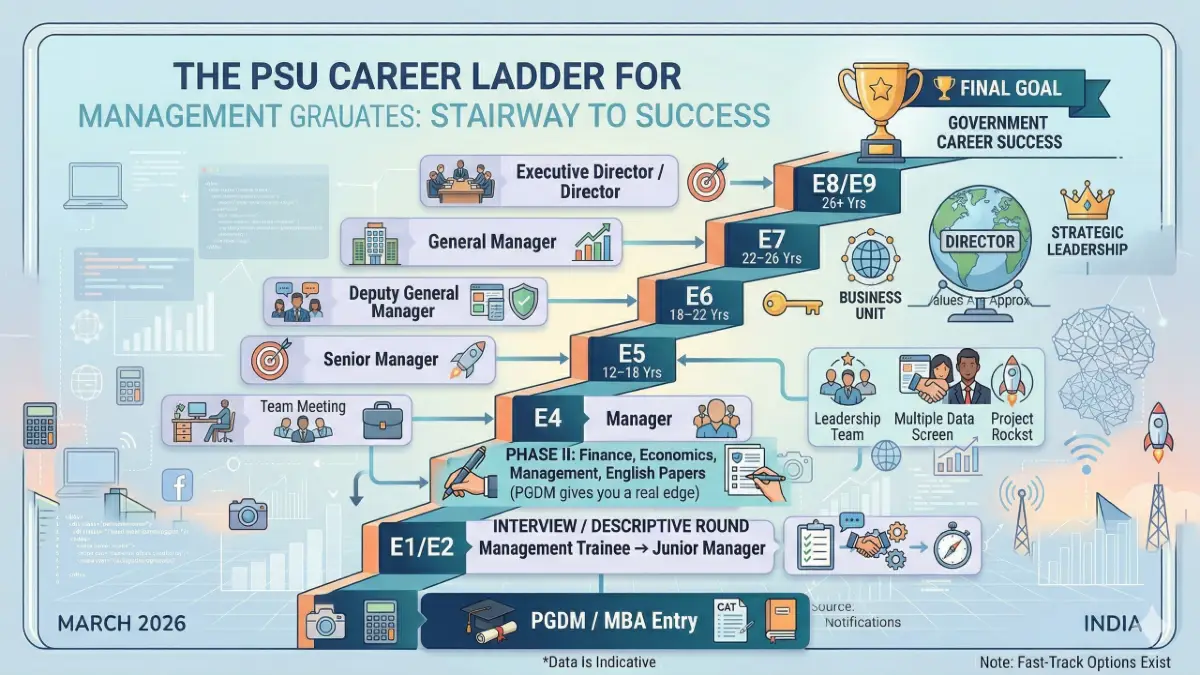
Share this on LinkedIn to help fellow management students visualize their PSU career path.
Each grade brings a pay band revision, enhanced allowances, and expanded responsibilities. Promotions combine time-based progression with performance-linked accelerated tracks.
Fast-Track Opportunities in PSUs
Many PSUs now have accelerated promotion policies for high performers — particularly in Navratna and Maharatna companies. Strong performers can reach Manager (E4) in 5–7 years instead of the standard 7–12.
PSUs also offer deputation opportunities — postings to government ministries, international subsidiaries, and joint venture companies — that add significant career diversity and professional visibility.
Delhi NCR Students: You Have a Built-In Location Advantage
Here’s something most PGDM students in Delhi NCR don’t fully appreciate — some of India’s most important PSU corporate headquarters are located right here in your backyard.
Major PSU Offices in Delhi NCR
CGO Complex, Lodhi Road, New Delhi
The CGO (Central Government Offices) Complex houses the corporate offices and ministry liaison divisions of several major PSUs and government departments — all within a single campus in Central Delhi.
SCOPE Complex, Lodhi Road, New Delhi
The SCOPE (Standing Conference of Public Enterprises) Complex is one of the most significant PSU office clusters in India. It houses the corporate headquarters of:
-
NTPC Limited — India’s largest power generation company
-
GAIL India — India’s leading natural gas transmission company
-
SAIL (Steel Authority of India) — India’s largest steel producer
-
ONGC (partial corporate office)
-
Engineers India Limited
-
Several other Navratna and Miniratna PSUs
IOCL Corporate Office — Yusuf Sarai, New Delhi
Indian Oil Corporation’s corporate headquarters sits in South Delhi — one of the most active management trainee recruiters among all PSUs.
ONGC Delhi Office — Scope Minar, Laxmi Nagar
ONGC maintains a significant Delhi corporate presence alongside its Dehradun headquarters.
Why This Matters for PGDM Students
If you study at a management institute in Delhi NCR — like Asia Pacific Institute of Management in New Delhi — you are geographically positioned closer to these PSU headquarters than students from almost anywhere else in India.
This translates into:
-
Campus recruitment visits — Delhi NCR PSU offices actively participate in placement drives at local management institutes
-
Pre-placement talks and networking events — Easier access to PSU HR teams and senior managers for informational interviews
-
Internship proximity — Many PSU corporate offices post internship openings that are practically accessible only to Delhi NCR students
-
Interview logistics — When final recruitment rounds happen at PSU Delhi offices, you’re already local — no travel costs, no hotel bookings, no logistics stress
For students and parents evaluating which management institute to attend with an eye on PSU careers — choosing a quality PGDM college in Delhi NCR like Asia Pacific Institute of Management puts you geographically and professionally closer to these opportunities than a college in any other city.
Conclusion
If you’ve been overlooking PSU jobs for management graduates because of outdated perceptions about government sector careers — it’s time to take a fresh look.
The salary structures are competitive. The perks add genuine financial value that most private sector packages simply don’t match. The career growth is structured and transparent. The Delhi NCR location gives local PGDM students a real proximity advantage. And with the 8th Pay Commission revisions expected to push PSU pay bands higher in 2026 — the financial case for PSU careers is stronger right now than it has been in years.
Whether you specialize in Finance, HR, Marketing, Operations, or Analytics through your PGDM programs — there’s a PSU role that aligns with your skills, values your education, and offers a career path you can plan your life around.
Start your research, target the right PSUs for your specialization, understand the eligibility for management trainees, and begin your preparation with the same energy you’d give any other career pursuit.
Frequently Asked Questions (FAQs)
1. What is the eligibility for management trainees in PSUs?
Most major PSUs require candidates to hold a full-time MBA or PGDM from an AICTE-recognized institute with a minimum of 60% aggregate marks. Some PSUs also require a minimum CAT, MAT, or GMAT percentile. Age limits typically range from 26 to 30 years for management trainee positions. Always verify the exact eligibility for management trainees directly on each PSU’s official careers page — ONGC, NTPC, GAIL — as criteria vary and notifications are updated annually.
2. Which PSUs are best for PGDM graduates in Finance?
ONGC, GAIL, IOCL, NTPC, and SAIL are among the top choices for career opportunities for PGDM in PSUs with a Finance specialization. These companies run large treasury, accounts, and financial planning operations that need well-trained finance professionals. RBI, NABARD, and LIC are also government-linked organizations that actively recruit Finance PGDM graduates.
3. Does studying in Delhi NCR give PGDM students an advantage for PSU jobs?
Yes — significantly. The SCOPE Complex, CGO Complex, and multiple PSU corporate headquarters (NTPC, GAIL, SAIL, IOCL, ONGC) are all located in Delhi NCR. PGDM students from Delhi NCR institutes benefit from campus recruitment proximity, easier access to PSU networking events, internship opportunities, and zero logistics cost during final interview rounds held at Delhi PSU offices.
4. How does PSU salary compare to private sector salary for fresh management graduates?
Entry-level PSU CTC of ₹12–18 LPA at major Navratna companies is broadly competitive with mid-tier private sector offers. When you add company housing or HRA, medical coverage, PF contributions, LTC, and other benefits — the effective total value of a PSU package often matches or exceeds private sector packages in the ₹15–20 LPA range. The 8th Pay Commission revisions expected in 2026 will push this comparison further in PSUs’ favor.
5. Is career growth in PSUs slower than in private companies?
Entry and mid-level growth in PSUs follows structured timelines that are generally slower than high-growth private sector roles. However, PSUs increasingly offer accelerated promotion tracks for strong performers — and the stability of progression is something no private sector company can guarantee. By E5–E6 level (Senior Manager / DGM), PSU compensation and responsibility levels are genuinely impressive.
6. Which PGDM specializations are most in demand for PSU Management Trainee roles?
Finance, HR, and Marketing are consistently the three most recruited PGDM programs specializations across major PSUs. Operations and Analytics specializations are growing in demand, particularly at tech-forward PSUs like NTPC, IOCL, and ONGC that are actively investing in digital transformation. Matching your specialization to the PSU’s core business area gives you both eligibility and a preparation advantage.