
Last Updated on January 24, 2026 by Vinod Saini
In India, career paths are many, but the prestige of a Sarkari Naukri in Railways stands in a league of its own. It is not just a job; it is an emotion for millions of aspiring professionals.
As one of the world’s largest employers, Indian Railways does not just offer employment; it offers a lifestyle. Whether you are a 10th-pass student looking for stability or an engineering graduate seeking technical challenges, the railways have a spot for you. However, with over 2 crore applicants for a few thousand seats, the competition is fierce.
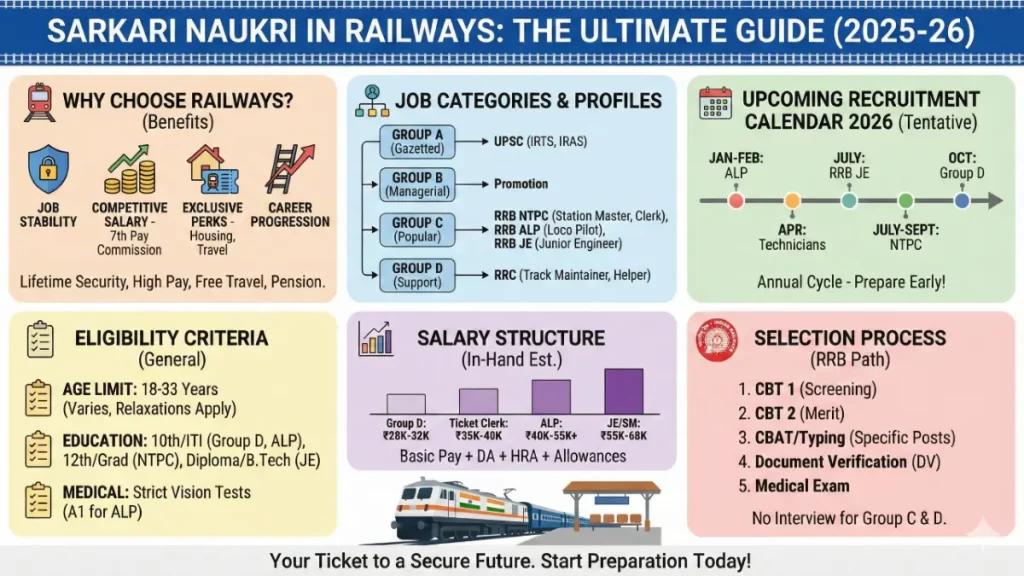
In this comprehensive guide, we will move beyond the basics. We will decode the Railway Recruitment 2026 calendar, analyze the salary structures under the 7th Pay Commission, and provide a roadmap to securing your seat in the Indian Railways.
- Why Choose a Career in Indian Railways?
- Major Railway Job Profiles & Categories
- Upcoming Railway Recruitment 2026: The Exam Calendar
- Eligibility Criteria for Railway Jobs
- Railway Salary Structure 2026 (7th Pay Commission)
- Step-by-Step Selection Process
- How to Apply for Sarkari Naukri in Railways
- Preparation Strategy: How to Crack the Exam?
- Conclusion
- Frequently Asked Questions (FAQs)
- Q1. What is the minimum educational qualification for a Railway Sarkari Naukri?
- Q2. Is there an interview for RRB Group C and D posts?
- Q3. Can final year college students apply for RRB NTPC?
- Q4. What is the age limit for railway jobs in 2026?
- Q5. How much salary does a Railway Group D employee get in hand?
- Q6. What is the best way to prepare for the Railway General Awareness section?
Why Choose a Career in Indian Railways?
Before we dive into the “how,” let’s understand the “why.” Why do millions of youth chase this specific Sarkari Naukri?
1. Unmatched Job Stability
In the private sector, market fluctuations can lead to layoffs. In contrast, a Sarkari Naukri in Railways offers lifetime job security. Once you clear the probation period, your employment is secure until retirement, barring extreme disciplinary actions.
2. Competitive Salaries (7th Pay Commission)
Gone are the days when government salaries were low. With the implementation of the 7th Pay Commission, railway employees enjoy salaries that often surpass private-sector counterparts at entry levels.
-
Dearness Allowance (DA): Revised biannually to beat inflation.
-
House Rent Allowance (HRA): Up to 27% of basic pay depending on the city (X, Y, or Z class).
3. Exclusive Perks and Allowances
The “hidden paycheck” in railways is massive.
-
Travel: Free or heavily discounted railway passes for you and your family.
-
Medical: Comprehensive healthcare at Railway Hospitals for the entire family.
-
Housing: Railway Quarters or leased accommodation.
-
Pension: A secure retirement plan (NPS).
4. Career Progression
The Indian Railways has a structured promotion hierarchy. A candidate joining as an Assistant Loco Pilot (ALP) can rise to become a Loco Inspector or even a Power Controller. Similarly, Group D employees can crack Departmental Exams (LDCE/GDCE) to move into Officer-level roles.
Major Railway Job Profiles & Categories
To prepare effectively, you must understand the different job categories. The Railway Recruitment Board (RRB) and Railway Recruitment Cells (RRC) classify jobs into four groups.
Group A: The Gazetted Officers
These are the highest-ranking officers in the railways, managing entire divisions or zones.
-
Recruitment Body: UPSC (Union Public Service Commission).
-
Exams: Civil Services Exam (CSE) and Engineering Services Exam (ESE).
-
Roles: Indian Railway Traffic Service (IRTS), Indian Railway Accounts Service (IRAS).
Group B: The Managerial Level
These posts are generally not open for direct recruitment. They are filled via promotion from Group C employees.
Group C: The Backbone of Railways (Most Popular)
This is where the bulk of Sarkari Naukri in Railways lies.
-
Recruitment Body: RRB (21 boards across India).
-
Key Roles:
-
NTPC (Non-Technical Popular Categories): Station Master, Goods Guard, Ticket Clerk, Typist.
-
ALP (Assistant Loco Pilot): The drivers of the trains.
-
Technicians: Maintenance staff for electrical and mechanical systems.
-
JE (Junior Engineer): Supervisors of engineering works.
-
Group D (Level 1): The Support Force
-
Recruitment Body: RRC.
-
Key Roles: Track Maintainer, Pointsman, Assistant (Workshop), Hospital Attendant.
Upcoming Railway Recruitment 2026: The Exam Calendar
Staying updated with the RRB Exam Calendar 2026 is critical. The Ministry of Railways has moved to an annual calendar system to streamline recruitment. Below is the tentative schedule for the 2026 cycle.
| Recruitment Category | Posts Included | Notification Month (Tentative) | Exam Period |
| RRB ALP | Assistant Loco Pilot | Jan – Feb 2026 | May – Aug 2026 |
| RRB Technicians | Signal & Telecom, Electrical | April 2026 | Oct – Dec 2026 |
| RRB NTPC | Station Master, Clerk, TC | July – Sept 2026 | Dec 2026 – Feb 2027 |
| RRB JE | Junior Engineer, DMS, CMA | July 2026 | Oct – Dec 2026 |
| RRB Group D | Level 1 Posts | October 2026 | Early 2027 |
Expert Tip: Do not wait for the official notification to start studying. The cycle is predictable now. If you want to crack RRB ALP, start your preparation in January itself.
Eligibility Criteria for Railway Jobs
A major reason candidates get rejected is failing to meet specific eligibility norms. Here is a breakdown of the requirements for a Sarkari Naukri in Railways.
1. Age Limit (General Category)
-
Group D (Level 1): 18 to 33 Years.
-
ALP & Technicians: 18 to 30 Years.
-
NTPC (Undergraduate): 18 to 30 Years.
-
NTPC (Graduate): 18 to 33 Years.
-
Junior Engineer (JE): 18 to 33 Years.
Note: Age relaxations apply: OBC (3 Years), SC/ST (5 Years), and PwBD (10 Years).
2. Educational Qualifications
The Indian Railways is unique because it offers jobs for almost every education level.
-
10th Pass / ITI: Eligible for Group D (Level 1) and ALP (ITI is mandatory for ALP).
-
12th Pass: Eligible for NTPC Undergraduate posts (Junior Clerk, Ticket Clerk).
-
Diploma / B.Tech: Mandatory for Junior Engineer (JE) and Senior Section Engineer (SSE).
-
Any Graduate: Eligible for NTPC Graduate posts (Station Master, Commercial Apprentice).
3. Medical Standards (The “A1” Factor)
This is often overlooked. Railway medical tests are strict.
-
A1 Category (For ALP): Must have 6/6 vision without glasses. No color blindness allowed.
-
B1/B2/C1: varying levels of visual acuity allowed for non-driving roles like Station Master or Clerk.
Railway Salary Structure 2026 (7th Pay Commission)
What does a Sarkari Naukri in Railways actually pay? The “Basic Pay” is just the starting point. The “In-Hand Salary” is usually 30-40% higher due to allowances.
Salary Snapshot Table
| Job Profile | Pay Level | Basic Pay (Entry) | Approx. Gross Monthly Salary |
| Group D (Helper/Trackman) | Level 1 | ₹18,000 | ₹28,000 – ₹32,000 |
| Ticket Clerk (TC) | Level 3 | ₹21,700 | ₹35,000 – ₹40,000 |
| Assistant Loco Pilot (ALP) | Level 2 | ₹19,900 | ₹40,000 – ₹55,000 (High OT/Running Allowance) |
| Junior Engineer (JE) | Level 6 | ₹35,400 | ₹55,000 – ₹65,000 |
| Station Master | Level 6 | ₹35,400 | ₹55,000 – ₹68,000 |
Step-by-Step Selection Process
The path to a railway job is a marathon, not a sprint. Here is the standard procedure for most RRB exams (NTPC, Group D, ALP):
-
CBT 1 (Computer Based Test): A screening round. Questions on Math, Reasoning, and General Awareness. (Usually 90 minutes, 100 questions).
-
CBT 2 (Mains): The merit-deciding round. Higher difficulty level.
-
CBAT / Typing Test:
-
CBAT (Psycho Test): Only for ALP and Station Masters to test reaction time and focus.
-
Typing Test: For Clerk and Typist posts.
-
-
Document Verification (DV): Scrutiny of your 10th/12th mark sheets, caste certificates, and ID proof.
-
Medical Examination: The final hurdle. You are tested for fitness relevant to your specific post.
How to Apply for Sarkari Naukri in Railways
Applying for these jobs has become entirely digital. Follow this checklist to ensure your application is not rejected.
Step 1: Identify Your Zone
Indian Railways is divided into zones (e.g., Northern Railway, Western Railway). You must apply to a specific Railway Recruitment Board (RRB) (e.g., RRB Allahabad, RRB Mumbai).
-
Tip: Choose a zone where vacancies are high, but be ready to work in that region for life.
Step 2: One-Time Registration (OTR)
Visit the official railway website (e.g., indianrailways.gov.in or regional RRB sites). Create an account using your Aadhaar card and mobile number.
Step 3: Fill the Application
-
Upload a clear, recent passport-size photo (light background).
-
Upload your signature.
-
Caution: Ensure your name matches exactly with your 10th-grade mark sheet. Even a small spelling error can lead to disqualification during Document Verification.
Step 4: Pay the Fee
-
General/OBC: Typically ₹500 (₹400 is refunded after you appear for the exam).
-
SC/ST/Female/Ex-Servicemen: ₹250 (Fully refunded after the exam).
Preparation Strategy: How to Crack the Exam?
With millions of applicants, “hard work” isn’t enough; you need “smart work.”
-
Master General Science (Group D Special): For Level 1 exams, Science (Physics, Chemistry, Biology of 10th level) holds huge weightage. Read NCERT books thoroughly.
-
Reasoning is Key: This is the most scoring section. Practice topics like Syllogism, Coding-Decoding, and Blood Relations daily.
-
Current Affairs: Focus on the last 12 months. Specifically, read about Railway developments (new Vande Bharat trains, budget allocations, new lines).
-
Mock Tests: Attempt at least one full-length mock test weekly. Analyze your weak areas. Speed is the game-changer in CBT 1.
Conclusion
A Sarkari Naukri in Railways is more than just a monthly paycheck; it is a ticket to a secure, respected, and comfortable life in India. While the competition is intense, the transparent recruitment calendar of 2026 gives you a clear advantage—you know exactly when the exams are coming.
Whether you are eyeing the technical prestige of a Junior Engineer or the operational thrill of an ALP, the key lies in early preparation and consistent practice. The Indian Railways is ready to welcome the next generation of workforce. Are you ready to board the train to success?
Next Step for You:
Check the official RRB website for your region today and download the syllabus for the post you are targeting. Start your preparation with “Previous Year Question Papers” to understand the exam pattern.
Frequently Asked Questions (FAQs)
Q1. What is the minimum educational qualification for a Railway Sarkari Naukri?
The minimum qualification depends on the post. For Group D (Level 1) posts, you need to be a 10th Pass or hold an ITI certificate. For clerical roles (NTPC), you need a 12th Pass certificate, while officer-level or engineering posts require a Graduate degree or Diploma.
Q2. Is there an interview for RRB Group C and D posts?
No. The Indian Government scrapped interviews for Group C and Group D posts (including NTPC, ALP, and Level 1) to ensure transparency. Selection is based purely on your performance in the Computer Based Tests (CBT) and Skill Tests (if applicable).
Q3. Can final year college students apply for RRB NTPC?
Generally, you must have your final degree or mark sheet in hand by the closing date of the application. However, you should carefully read the specific notification (CEN) for that year, as rules can vary slightly.
Q4. What is the age limit for railway jobs in 2026?
For most General category candidates, the age limit is 18-33 years for NTPC and Group D, and 18-30 years for ALP. However, there are age relaxations: 3 years for OBC (Non-Creamy Layer) and 5 years for SC/ST candidates.
Q5. How much salary does a Railway Group D employee get in hand?
A Group D employee starts at Level 1 with a Basic Pay of ₹18,000. After adding DA (Dearness Allowance), HRA (House Rent Allowance), and T.A. (Travel Allowance), the in-hand salary usually ranges between ₹26,000 to ₹30,000 per month, depending on the posting location.
Q6. What is the best way to prepare for the Railway General Awareness section?
Focus heavily on NCERT Science books (Class 9 & 10), as science questions are frequent. Additionally, stay updated on current affairs from the last 6-12 months, and study static GK related to Indian Railways (history, zones, and recent modernization projects).